What Is Agentic SEO? A Complete Guide for 2026


What is agentic SEO? Agentic SEO is the practice of using AI agents to run SEO as a continuous, closed-loop system: monitor performance and AI visibility, discover opportunities, turn them into tasks, execute fixes, and measure the result. Then repeat, automatically, instead of waiting for next month’s audit.
Search stopped being a list of blue links a while ago. Most people now ask ChatGPT, Gemini, Claude, or Perplexity a question directly – and the answer either mentions your brand or it does not. That single change is why I keep coming back to one term: agentic SEO.
I have written about pieces of this before — once about why rankings alone stopped being enough, and once about the shift I saw in my own Search Console data with my GEO tracking experiment. This guide is the one I wish I had written first: a clear definition of what agentic SEO is, how it differs from GEO and AEO, how AI agents actually evaluate and act on your content, and what a real implementation looks like.
What Is Agentic SEO?
Agentic SEO is the practice of using AI agents – not just AI-written content, actual autonomous agents – to run SEO as a continuous, closed-loop system: monitor performance and AI visibility, discover opportunities, turn them into tasks, execute the fixes, and measure the result. Then repeat, automatically, instead of waiting for next month’s audit.
The word that matters is “agentic.” It is not about using AI to draft blog posts faster. It is about handing the workflow- research, prioritization, execution, QA, monitoring – to agents that act with a defined role and a feedback loop. At the same time, a human stays in charge of strategy and approvals.
In one sentence: Agentic SEO = AI visibility tracking + workflow automation + human oversight, run as one continuous system instead of five disconnected tools.
Agentic SEO vs Traditional SEO vs GEO vs AEO
These terms get used interchangeably, which causes most of the confusion. They are not competitors — they are layers.
| Term | What It Optimizes For | What It Produces |
|---|---|---|
| Traditional SEO | Ranking position on Google/Bing SERPs | Reports: keyword positions, backlinks, technical issues |
| GEO (Generative Engine Optimization) | Being cited inside AI-generated answers (ChatGPT, AI Overviews, Perplexity) | Visibility data: are we mentioned, how often, in what context |
| AEO (Answer Engine Optimization) | Structuring content so it is directly extractable as the answer (featured snippets, voice answers, AI summaries) | Extractable, well-structured content: clear headers, FAQ blocks, direct answers |
| Agentic SEO | Running all of the above as one continuous, agent-executed system | Actioned work: audits that become tasks, tasks that get done, results that feed the next cycle |
Traditional SEO tells you where you rank. GEO tells you whether AI assistants recommend you. AEO shapes how you write so an answer engine can lift a clean answer out of your page. Agentic SEO is the operating layer that sits on top of all three – it is what actually closes the gap between “here is what is wrong” and “here is what got fixed.”
I ran a dedicated 30-day GEO tracking experiment across four AI engines if you want to see the visibility-tracking layer in isolation before it is wired into an agentic workflow.
None of these replace the others. Technical SEO, backlinks, and content quality are still the foundation. Agentic SEO does not skip that work – it makes sure it actually gets done, continuously, instead of sitting in a spreadsheet.
How AI Agents Evaluate and Act on Your Content
This is the part most explainers skip. There are really two different kinds of AI agents at work here, and understanding what is agentic SEO depends on both.
1. The AI Agents Doing the Searching
ChatGPT, Perplexity, Gemini, and AI Overviews evaluate your content the way a very fast, very literal reader would:
- Can they extract a clear, self-contained fact or answer from a section without needing the rest of the page for context?
- Is the structure (headers, lists, tables, FAQ schema) unambiguous enough to quote accurately?
- Does the brand show up consistently enough across the web that the model already “knows” it, rather than having to gamble on an unfamiliar name?
- Is the source still fresh, or is there a more recently updated page saying the same thing more clearly?
2. The AI Agents Doing the SEO Work
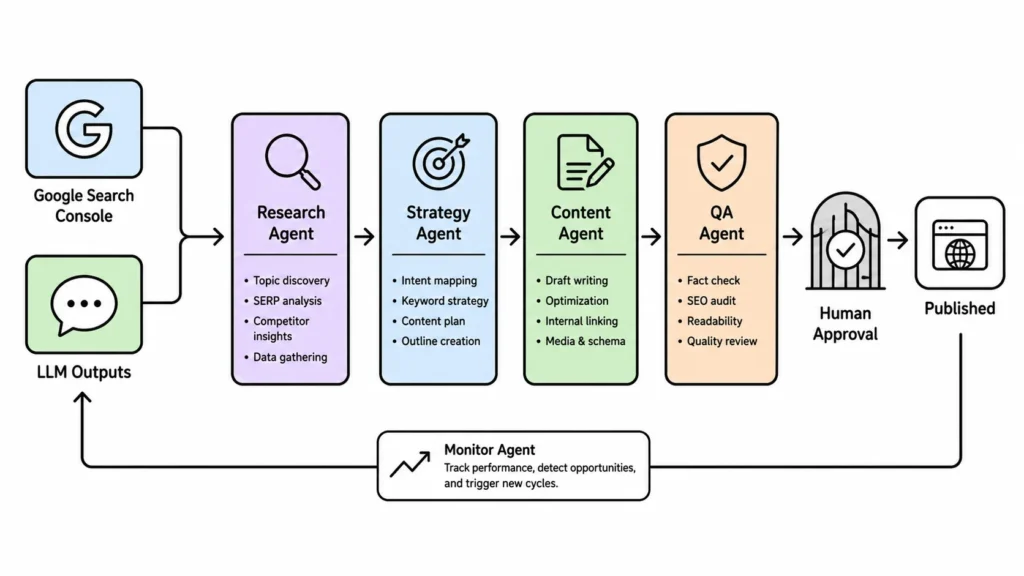
In an agentic SEO system, agents typically split into distinct roles:
| Agent Role | What It Does |
|---|---|
| Research agent | Reads Search Console data, flags dropping-impression pages, low-CTR pages, and query gaps with no matching content |
| Strategy agent | Turns research into prioritized decisions: rewrite this intro, add an FAQ here, build a new page for that query cluster |
| Content agent | Drafts the actual fix: revised H1, restructured intro, new FAQ section, or a full new post, written to be both human-readable and easy for AI engines to extract from |
| QA agent | Checks the draft for accuracy, internal-link hygiene, schema correctness, and whether it still sounds like a human wrote it rather than a generic model |
| Monitor agent | Runs on a schedule (nightly or weekly), watches for impression and CTR movement on anything recently changed, and feeds the result back into next week’s research pass |
That is the actual mechanism behind “AI agents doing SEO.” It is not one model doing everything. It is a small pipeline of narrowly scoped agents, each handling one stage, with a human approving before anything ships.
Technical Risks and Safeguards
No agent pipeline runs perfectly every time. Three risks worth planning for:
- LLM hallucinations in content drafts – A content agent might confidently generate a statistic or a product claim that sounds correct but is not. The safeguard: every content draft goes through a QA agent that cross-checks factual claims against source material before a human ever sees it. If the QA agent flags a claim it cannot verify, the draft goes back to revision instead of forward to approval.
- Context drift across audit runs – Over weeks, an agent’s understanding of what “good SEO” means can drift slightly. It starts prioritizing different signals than it did initially. The safeguard: weekly snapshots of agent output quality that flag when recommendations start changing in direction without a corresponding change in data. If the monitor agent detects drift, it re-anchors the agent’s instructions to the original playbook.
- API compute costs – Every agent run consumes API credits – LLM calls, DataForSEO queries, browser sessions. Left unmanaged, costs can spike unexpectedly. The safeguard: hard budget limits at the project and agent level. If an agent hits its budget cap, execution pauses automatically rather than running up charges. These safeguards are built into the visibility.so platform. If you are building your own stack, they are worth implementing before you scale past a single project.
The Five-Layer Loop Behind Every Agentic SEO System
Strip away the tooling and every agentic SEO setup runs the same loop:
Layer 1: AI Visibility Monitoring
Track brand mentions and citation frequency across ChatGPT, Claude, Gemini, Perplexity, and Google AI Overviews. The question shifts from “where do we rank?” to “when AI answers questions in our space, does it mention us?”
Layer 2: Opportunity Discovery
Surface content gaps, technical issues, stale pages, and citation gaps (places competitors get cited and you do not) from real data, not guesswork.
Layer 3: Task Orchestration
Every discovered opportunity becomes an assigned, trackable task automatically. No copy-pasting findings from an audit tool into a project tracker.
Layer 4: Human + AI Collaboration
Agents handle recurring audits, monitoring, and first-draft execution. Humans keep strategy, approvals, and creative judgment.
Layer 5: Continuous Measurement
Every action gets checked against what actually moved: visibility, traffic, task completion rate, share of voice. Optimization becomes ongoing instead of quarterly.
A Real Example: Running This on My Own Site
I am not describing this loop in the abstract. I ran it on sanjayshankar.me. Over three months, the site went from near-flat impressions to roughly 28,700 impressions and 309 clicks, almost entirely from a small cluster of posts about my own tools. No link-building push. No manual keyword spreadsheet.
The pattern that stood out in the data: the top queries were not generic keywords. They were brand plus intent searches – “openclaw coolify,” “how to use mirofish” – people already looking for something specific, with my post as the answer. That is the difference between chasing rank for volume and owning a query because you are already the clearest source.
My agent pipeline did not create that content. It kept finding the highest-leverage tweaks: restructuring H2 and H3 headers to match how people were actually phrasing queries, adding FAQ sections for sub-queries, and fixing internal linking between related posts so the cluster reinforced itself.
None of that required me to sit down and manually rewrite pages every week. It required defining the workflow once and reviewing what the agents proposed.
Why the Existing SEO Tool Stack Does Not Cover This
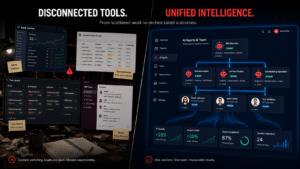
Most teams currently run three disconnected categories of tools, and the seams between them are exactly where agentic SEO earns its keep:
| Tool Category | What It Does Well | What It Misses |
|---|---|---|
| Traditional SEO suites (Semrush, Ahrefs, Moz) | Rank tracking, site audits, backlink data | Stop at the report. No AI visibility tracking, no execution layer |
| AI visibility trackers | Tell you whether ChatGPT or Perplexity mention your brand | Knowing you have a citation gap is not the same as closing it |
| AI content platforms | Generate briefs and drafts | Content is one slice of the workflow. Technical fixes, refreshes, and approvals still happen somewhere else |
Five tools, one workflow, and context lost at every handoff between them. Agentic SEO exists specifically to collapse that into one system, see how technical SEO audits themselves can be run end-to-end by AI agents rather than producing a report someone has to manually action.
Visibility.so: An Example Implementation
I am building visibility.so precisely because “another dashboard” was not the gap – execution was. It is the clearest example I can point to of agentic SEO implemented as a product rather than a personal script:
| Capability | visibility.so | Semrush | Ahrefs | Moz |
|---|---|---|---|---|
| AI visibility / GEO tracking | ✅ | ❌ | ❌ | ❌ |
| AI agents that execute SEO tasks | ✅ | ❌ | ❌ | ❌ |
| Auto-recurring technical audits | ✅ | ❌ | ❌ | ❌ |
| Content opportunity pipeline | ✅ | ✅ | ✅ | ❌ |
| Keyword tracking | ✅ | ✅ | ✅ | ✅ |
| Human + AI task board (shared org chart) | ✅ | ❌ | ❌ | ❌ |
The mechanics match the five-layer loop described above: Search Console and AI-visibility data feed in, agents turn findings into assigned tasks on a shared Kanban board alongside human teammates, and a monitor pass checks whether the change actually moved the numbers. Nothing here replaces good SEO fundamentals — it just makes sure the fundamentals get done, on a loop, instead of living in a backlog.
How to Get Started with Agentic SEO
You do not need a full agent stack on day one. A reasonable path:
- Start tracking AI visibility, not just rankings — pick 3-5 prompts your customers would realistically ask, and check monthly whether ChatGPT, Perplexity, and AI Overviews mention you
- Pick one recurring audit (technical health or content freshness) and automate the reporting first, before automating execution
- Give agents narrow, specific jobs — a research agent that flags issues, not one agent trying to “do SEO.” Scope beats ambition here
- Keep a human approval gate on anything that publishes. Agents draft; humans confirm
- Measure the loop, not just the output — did the fix move impressions, clicks, or citation frequency? If you cannot answer that, the loop is not closed yet
Frequently Asked Questions
Is agentic SEO the same as GEO?
No. GEO (Generative Engine Optimization) is about visibility inside AI-generated answers specifically. Agentic SEO is broader — it includes GEO as one tracked signal, alongside traditional rankings, and adds the automation layer that turns findings into completed work. See GEO vs AEO vs Agentic SEO for a full comparison.
Is agentic SEO the same as AEO?
No. AEO (Answer Engine Optimization) is a content structuring discipline — writing so an answer engine can extract a clean answer. Agentic SEO is the operating system that includes AEO as a practice but also runs the monitoring, task orchestration, and measurement around it.
Does agentic SEO replace traditional SEO?
No. It builds on it. Technical SEO, content quality, and backlinks are still the foundation. Agentic SEO adds continuous orchestration and AI-visibility tracking on top.
Will AI agents replace SEO professionals?
No. Agents handle repetitive monitoring and first-draft execution. Humans still own strategy, approvals, and the judgment calls that data alone cannot make.
How is visibility.so different from Semrush or Ahrefs?
Semrush and Ahrefs are analytics platforms — they show you what is wrong. Visibility.so is an execution platform — it tracks AI visibility (GEO) and connects findings directly to agents that act on them, with humans approving along the way.
Do I need a custom agent stack to do this myself?
No. You can build one from scratch (I did, on Paperclip + OpenClaw), or use a platform like visibility.so that already runs the loop. The DIY open-source approach gives you full control and is free on infrastructure, but requires engineering time to wire up and maintain the pipeline. A platform approach removes that overhead in exchange for a monthly cost. The workflow matters more than the specific tools – choose whichever lets you focus on results instead of plumbing.
What is the first step to implement agentic SEO?
Start by tracking AI visibility — pick 3-5 prompts your customers ask, and check whether ChatGPT, Perplexity, and Gemini mention your brand. That tells you whether you have a GEO gap before you invest in the full agentic workflow.
Found this useful? Share it with someone still asking “what is agentic SEO?” Follow @sanjayshankarr for more on AI search and hybrid team workflows.