AI Product Manager vs Technical Program Manager: 5 Key Differences


AI Product Manager vs Technical Program Manager – same person, different work. I have been introduced as a technical project manager, a program manager, and more recently a co-founder building AI products. Same person, same decade-plus of shipping software. The title kept changing because the work underneath it kept changing.
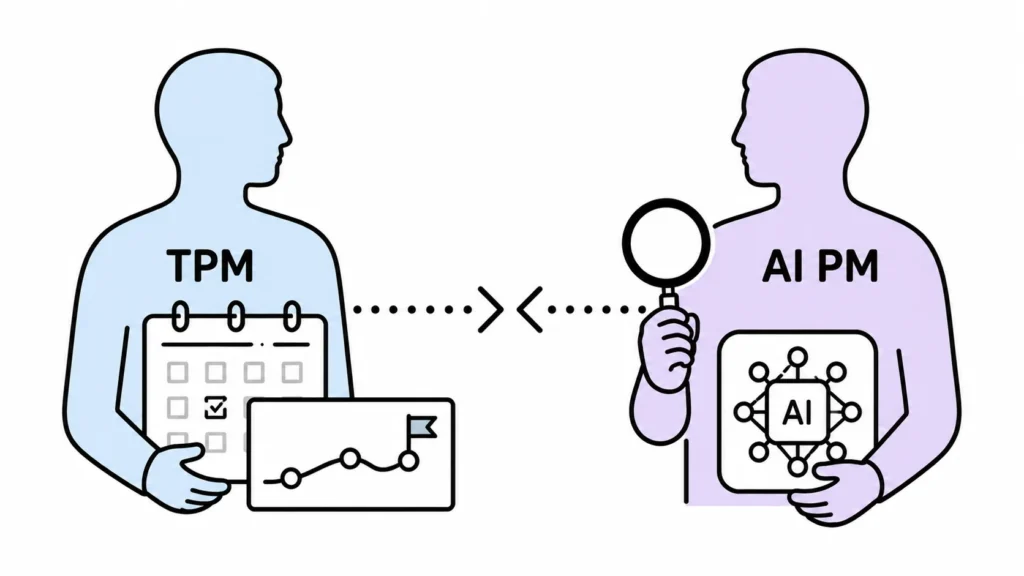
In 2026, that shift has a name people are searching for: AI Product Manager. And a lot of Technical Program Managers are asking the same question I get asked on calls – is this a new job, or is it just my job with a new label?
The honest answer is: it is both, depending on which half of the role you are standing in. Here is how I have come to draw the line, after 14 years moving between TPM, program manager, and now product leadership at visibility.so.
What a Technical Program Manager Actually Does
A TPM’s job is certainty. You are the person who takes a roadmap that fifteen stakeholders agree on in theory and makes sure it survives contact with reality – sprints, dependencies, a backend team that is blocked on a design team that is blocked on a client sign-off.
When I was a TPM at Acodez, my day looked like this:
- Translating client requirements into sprint-sized work
- Tracking cross-team dependencies before they became fire drills
- Protecting the team’s time from scope creep
- Reporting status upward in a way that did not need a follow-up meeting to explain
None of that requires you to decide what the product should be. It requires you to make sure what has already been decided actually ships, on time, without the team burning out getting there.
What “AI Product Manager” Actually Means
The AI Product Manager title gets used loosely. It is not “a PM who uses ChatGPT.” It is a product owner whose core decisions are now about models, data, and agent behavior instead of just features and flows.
That means owning questions a traditional PM roadmap never had to answer:
- Which tasks get delegated to an autonomous agent, and which stay human-reviewed?
- What does “done” mean for output that is probabilistic instead of deterministic?
- How do you spec acceptance criteria for a feature whose behavior can drift after launch?
- Where is the line between a genuinely useful AI feature and AI theater bolted onto a roadmap slide?
This is product management with a research and judgment layer added on top – closer to being the discovery function than the delivery function.
5 Key Differences
| Dimension | Technical Program Manager | AI Product Manager |
|---|---|---|
| Core question | Will this ship on time? | Should this exist, and can we trust its output? |
| Primary tool | Roadmaps, sprint boards, RAID logs | Evals, prompt/agent specs, usage data |
| Success measure | Predictability, delivery velocity | Adoption, trust, output quality over time |
| Failure mode | Missed dependency, blown timeline | Confidently wrong output shipped to users |
| Where they sit | Between teams | Between the model and the market |
Why the Two Roles Are Colliding in 2026
Here is the part most “PM vs TPM” comparisons miss: this is not a static org chart question anymore, because AI agents are quietly absorbing the coordination work TPMs used to do by hand.
Status rollups, dependency tracking, even first-draft specs – I run small internal agents that handle a chunk of that today. When the coordination overhead of the TPM role shrinks, what is left of your time has to go somewhere, and it is going toward product judgment: deciding what the agents should be doing in the first place, not just tracking whether they did it.
That is the convergence. Not “TPMs are being replaced by AI PMs.” It is that the TPM skill set (systems thinking, cross-team fluency, comfort with ambiguity under a deadline) is exactly the raw material an AI Product Manager needs. You are just pointing it at a different question.
The Builder-PM vs Integrator-PM Split
Inside “AI Product Manager,” I see the role splitting into two distinct tracks in 2026.
The Builder-PM
Builder-PMs prototype the thing themselves – wiring up an agent workflow, testing a model behavior hands-on, shipping a rough version before writing a formal spec. The spec comes after the prototype proves the idea works, not before.
This is the track I lean toward. When we wanted to stress-test a product idea at visibility.so, I did not start with a requirements doc. I ran the concept through a market simulation first and let the results shape the spec. That is builder-PM behavior: build a cheap version of the answer before you commit a team to building the real one.
The Integrator-PM
Integrator-PMs operate a layer up. They are evaluating vendor models, setting policy for how AI features get reviewed before launch, and translating technical risk (hallucination rates, data privacy, model drift) into language legal, sales, and leadership can act on. Less hands-on-keyboard, more hands-on-judgment.
Neither track is more senior than the other. They are different bets on where you are most valuable.
A Working Framework for Choosing Your Path
If you are a TPM wondering where to point your career in 2026, ask yourself which sentence sounds more like you:
Path 1: Deepen program management with AI fluency.
I want to be the person who makes sure the plan we agreed on actually happens. Stay close to program management, but add model literacy, agent architecture basics, and eval design. You will be the person orgs trust to ship AI features without them turning into liabilities.
Path 2: Push toward product.
I want to be the person who decides what we build in the first place. Use your TPM background as an unfair advantage – most PMs cannot scope technical risk the way a former TPM can.
Either way, the title matters less than it used to. The question that matters is: are you optimizing for certainty, or for judgment under uncertainty?
Frequently Asked Questions
Is an AI Product Manager just a Technical Program Manager with a new title?
No. The titles are converging in skill set, not in function. A TPM’s job is delivery certainty. An AI PM’s job is deciding what should be built and whether its output can be trusted – a discovery function, not a delivery one.
Do I need a technical background to become an AI Product Manager?
It helps more than it does in traditional product management, because you need enough fluency to judge model output, evaluate technical tradeoffs, and spec acceptance criteria for probabilistic features. A TPM background is a strong starting point.
What should a TPM learn first to move into AI product management?
Start with how the models you are building on actually fail – prompt sensitivity, hallucination patterns, data dependencies – before worrying about frameworks or certifications. Judgment about failure modes is the transferable skill.
Is program management becoming obsolete because of AI agents?
The coordination tasks are shrinking, not the role. AI agents are absorbing status tracking and rollups, which frees TPMs to spend more time on the judgment-heavy work that is now in higher demand, not less.
Which pay is higher – AI PM or TPM?
AI PM roles currently command a premium because the skill set is rarer and the demand is higher. But experienced TPMs with AI fluency are the fastest-growing segment and can command similar compensation.
Found this useful? Share it with a TPM wondering whether to move into AI. Follow @sanjayshankarr for more on career growth in AI.