Agentic SEO Services: What They Actually Include


Quick answer: A legitimate agentic SEO service includes continuous automated audits, autonomous monitoring that opens tasks, content agents with human approval, and AI visibility tracking across ChatGPT, Gemini, and Perplexity. If a vendor cannot show you live agent runs or name the specific AI platforms they track, you are likely buying a rebranded retainer.
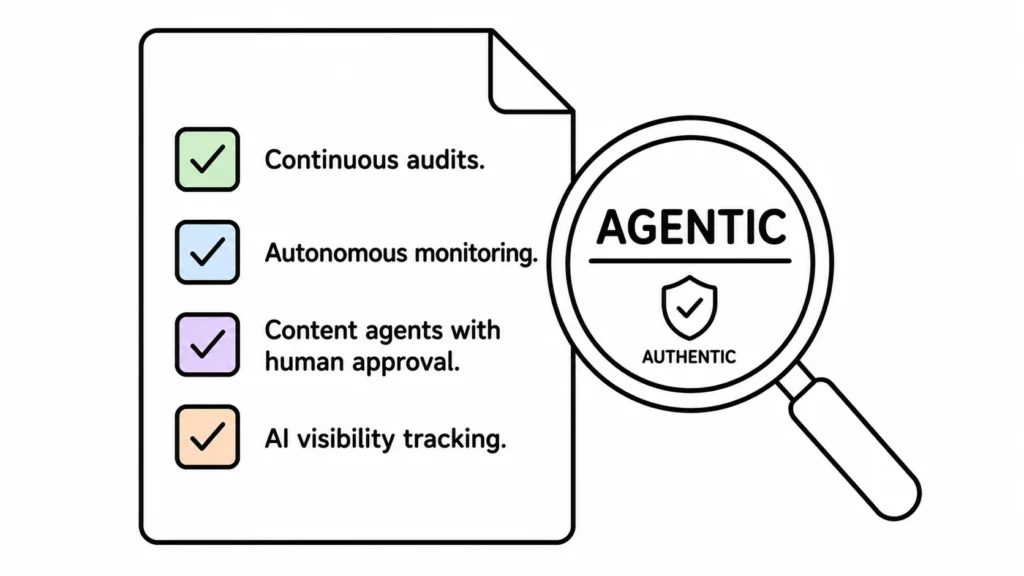
A legitimate agentic SEO service should include four things you can verify, not just describe: continuous automated audits, autonomous monitoring that opens and tracks fixable tasks, content agents with human approval gates, and AI visibility tracking across ChatGPT, Gemini, and Perplexity – not just Google rank position.
“Agentic SEO” turned into a category almost overnight. Every SEO agency now has the word somewhere on its homepage. Some of them earned it. Most of them did not.
I have seen this pattern before. The same thing happened with “AI-powered SEO” in 2023, and before that with “growth hacking.” When demand outstrips supply, the fastest response is to rename what you already offer.
As someone building an actual agentic SEO platform (visibility.so), I have had enough calls with vendors claiming “agentic” capabilities to know what real agentic SEO looks like. I wrote about what agentic SEO actually is a few weeks ago. This piece is not that. It is for the moment after you have decided you want this and you are now looking at vendor decks that all use the same buzzwords.
Why “Agentic SEO Services” Became a Rebrand Magnet
Two things happened at once. First, AI visibility became a real, trackable metric – brands started noticing they existed in ChatGPT answers or did not, independent of where they ranked on Google. Second, every agency watched their retainer clients start asking about it. The fastest way to answer that demand is not to build agent infrastructure. It is to rename the service.
That is not automatically dishonest. Some agencies genuinely added AI visibility reporting and are calling it “agentic” a little early. But a meaningful number are selling the same human-run process with new vocabulary. The only way to tell the difference is to ask specific questions about what is actually running.
What a Real Agentic SEO Engagement Should Include
1. Continuous, Agent-Run Audits
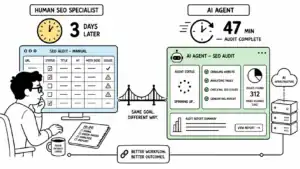
Traditional technical SEO audits are a person crawling your site once a quarter and handing you a spreadsheet. A real agentic version runs weekly or even daily. An agent crawls, diagnoses, deduplicates against issues it already flagged, and creates tasks automatically.
The output is not a report you read once. It is a live queue of actionable tasks that stays up to date. I have written about how this pipeline works in practice if you want the mechanics.
Ask the vendor: Can I see a recent audit run, not just a sample report?
2. Autonomous Monitoring That Acts
A rank tracker that emails you when a keyword drops is monitoring. An agent that notices the drop, checks whether a competitor shipped new content, drafts a task with a specific recommended fix, and assigns it – that is autonomous monitoring.
The distinction matters: does their system generate a task with a recommendation, or does it generate a notification you still have to interpret? The first is agentic. The second is a dashboard with better copywriting.
Ask the vendor: What triggers a task, and who approves it before it ships?
3. Content Agents With Human Approval Gates
This is the capability vendors oversell most often. “AI-generated content at scale” is not a content agent. A legitimate content agent works from a brief tied to a specific keyword and search intent, produces a draft in your brand voice, and routes it to a human for review before it publishes.
Real content agents also structure content specifically for AI retrieval. This means:
- Explicit entity definitions – key terms and concepts are defined clearly on first mention so an LLM can extract the relationship without guessing
- Schema markup – FAQPage, HowTo, and Article schema are baked into the content structure, not added as an afterthought
- Direct Q&A formatting – each section answers one question clearly in the first sentence, with supporting detail following. This mirrors how RAG pipelines retrieve and rank snippets
- Concise summary paragraphs – the first 50-100 words of each section serve as a self-contained summary that an AI can use even if it only grabs one chunk
- Heading-as-answer structure – H2 and H3 headings contain the key takeaway, not just a label. “How X Improves Y” instead of “Introduction”
These techniques bridge the gap between human readability and machine retrieval. They make content work for both readers and AI citation systems.
If a vendor’s pitch is “we publish X articles a week fully automatically,” that is a volume play. Ask about their editorial rejection rate instead.
Ask the vendor: What happens when the agent is wrong? How do errors get caught before they reach your site?
4. AI Visibility Tracking Across the Platforms Your Buyers Actually Use
This is the newest and most commonly faked layer. Real AI visibility tracking means running actual prompts against ChatGPT, Gemini, Claude, Perplexity, and Google AI Overviews on a schedule. It means recording whether and how your brand shows up – not estimating it from backlinks or inferring it from rank data.
I ran a 30-day GEO tracking experiment across four AI engines. The patterns were clear: each engine has different citation behavior, and you cannot optimize what you do not measure.
Ask the vendor: Which AI platforms do you actually test on, and how often?
5. Off-Page AI Trust and Entity Signals (The Missing Layer)
Most agentic SEO services focus entirely on on-page audits, tasks, and content. But over 80% of LLM citations rely on third-party web consensus – how consistently your brand appears across the broader web. An agentic SEO service should also manage:
- Entity consistency – your brand name, description, and categories should appear the same way across Wikipedia, Crunchbase, LinkedIn, and industry directories. LLMs build entity recognition from repetition across sources, not from a single perfect page.
- Knowledge Graph presence – Google’s Knowledge Graph feeds into Gemini and AI Overviews. A service that ignores Knowledge Graph optimization is missing a primary AI visibility channel.
- Co-occurrence signals – how often your brand is mentioned alongside relevant entities (competitors, industry terms, partner brands). LLMs use co-occurrence to determine topical relevance.
- Citation gap monitoring – tracking which competitors get cited in AI answers that you do not, and identifying the specific content or authority gap causing it.
If a vendor’s “AI visibility” strategy is limited to on-page content changes, they are only solving half the problem. GEO citations depend heavily on what the rest of the web says about you.
Ask the vendor: How do you track and improve off-page entity signals and third-party citations?
Real Service vs Rebranded Retainer – Comparison
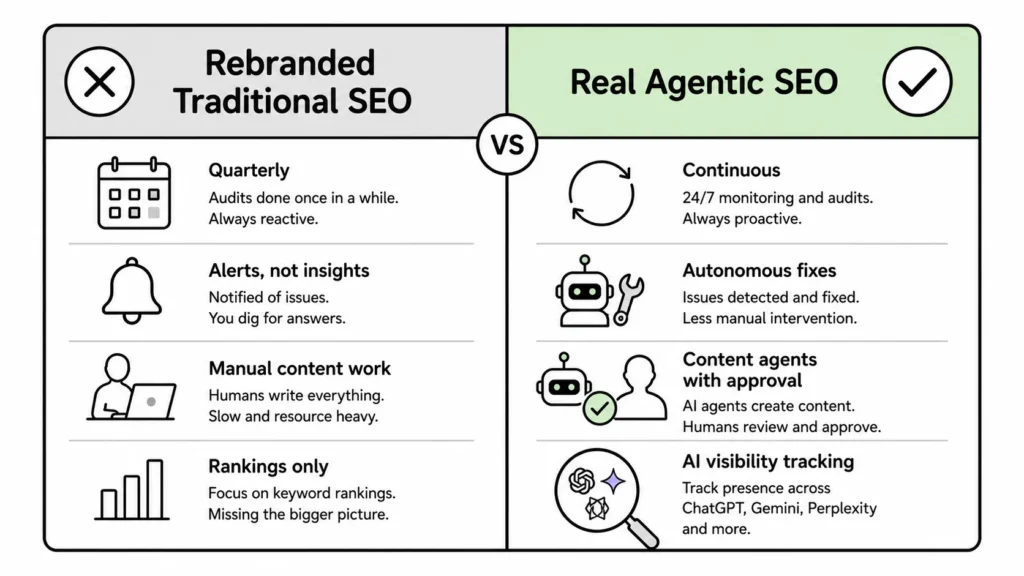
| What You Are Evaluating | Rebranded Traditional SEO | Real Agentic SEO Service |
|---|---|---|
| Audit cadence | Quarterly, manual, delivered as PDF | Continuous, agent-run, delivered as live task queue |
| Monitoring | Rank-tracking alerts you interpret yourself | Agents detect issues and open tasks with recommended fixes |
| Content | Writer working off a content calendar | Content agent from keyword briefs, human-reviewed before publish |
| AI visibility | Not tracked, or inferred from rank data | Directly tested against ChatGPT, Gemini, Perplexity, Claude |
| What you can see | A monthly report | The agents’ actual task history and run logs |
| Pricing | Flat retainer regardless of output | Scales with what is running – projects, agents, keywords |
The Vendor Checklist – Questions to Ask Before You Sign
Bring these into the sales call. A vendor with a real agentic SEO service will have specific answers to all of them. A rebrand will get vague fast.
- Can I see an audit run, not just a sample report? Ask them to show a live or recent agent run, including what it flagged and what task it created – not a polished case study.
- What triggers a task, and who approves it before it ships? You want a clear line between “the agent recommends” and “a human confirms” – especially for anything that touches content or code.
- Which AI platforms do you actually test visibility on, and how often? “AI visibility” with no named platforms or no stated frequency is a marketing slide.
- What happens when the agent is wrong? Every agent misfires sometimes. Ask about dedup logic, human review gates, and rollback before issues reach your site.
- Does the pipeline learn from editor rejections? If your editor rejects a content draft or overrides an audit recommendation, does the agent adjust its future behavior? Or does it keep producing the same kind of output? A real agentic service should improve over time, not repeat the same mistakes.
- Can I own the data if I cancel? Ask what you keep access to – task history, audit history, visibility history – versus what disappears when the vendor relationship ends.
- Is pricing tied to what is running, or is it a flat retainer? A real agentic platform usually scales with projects or keywords because the underlying costs (API calls, crawl volume) actually vary.
Where visibility.so Fits
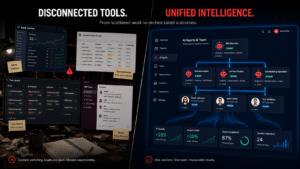
I am building visibility.so because execution was the gap that no tool was solving. Semrush and Ahrefs show you what is wrong. Visibility.so connects findings to agents that act on them, with humans approving along the way.
If you want to run the checklist above against an actual agentic platform rather than taking a vendor’s word for it, visibility.so offers a 7-day free trial. The agent run history and task queue are the product itself – not a report we send you afterward. Plans start at $99/month.
Frequently Asked Questions
Is “agentic SEO services” just a new name for AI-assisted SEO consulting?
Sometimes. AI-assisted means a person uses AI tools to do their existing job faster. Agentic SEO means autonomous agents run defined parts of the workflow – audits, monitoring, drafting – with humans approving output rather than producing all of it. Ask which one you are actually buying.
How much should agentic SEO services cost?
Traditional retainers are flat regardless of output. Agentic services more often scale with what is running – number of projects, agents, or keywords tracked – because the underlying costs (crawling, AI API usage) scale that way too.
Do I still need an SEO strategist if I buy agentic SEO services?
Yes. Agents execute. They do not set strategy, understand your business context, or make judgment calls about brand voice and priorities. The best vendors treat agents as the execution layer under human strategy.
What is the difference between this and GEO services?
GEO specifically covers optimizing for visibility inside AI-generated answers. It is one input into agentic SEO, not the whole thing. Agentic SEO also covers technical audits, task orchestration, and on-page work, with GEO as the AI visibility layer on top.
Can I trial an agentic SEO service before committing?
You should be able to. visibility.so offers a 7-day free trial for exactly this reason – a real agentic platform has nothing to hide by letting you watch it run before you pay.
Found this useful? Share it with someone evaluating “agentic” vendors right now. Follow @sanjayshankarr for more on AI search and hybrid team workflows.