Quick answer: AI search engines do not rank your page the way Google does. They take a user prompt, break it into multiple smaller search queries, pull results from traditional search indexes through retrieval-augmented generation, grab short chunks of content instead of full pages, and synthesize an answer with citations. If your content is not structured to survive that process, you lose visibility regardless of how well you rank on Google.
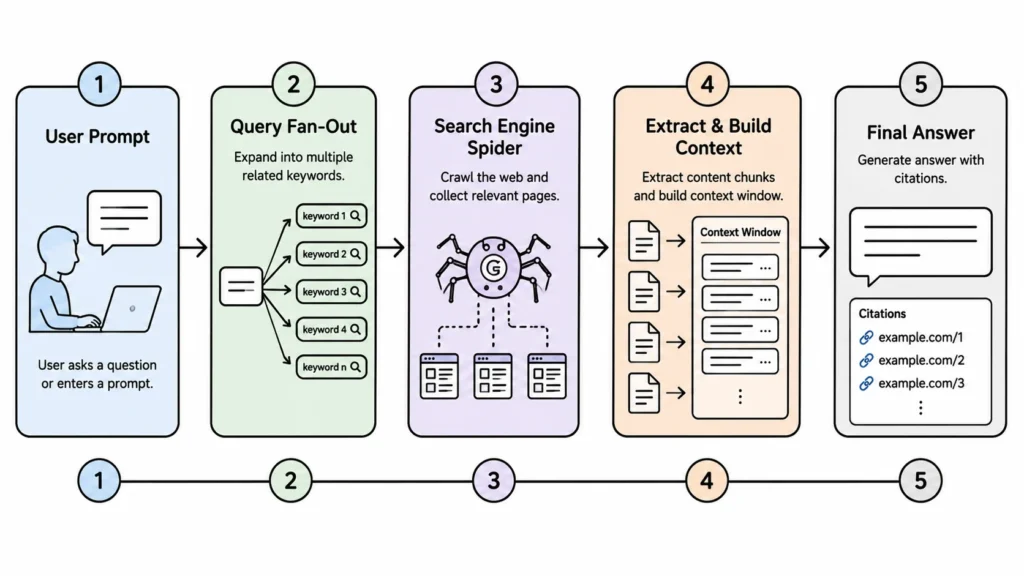
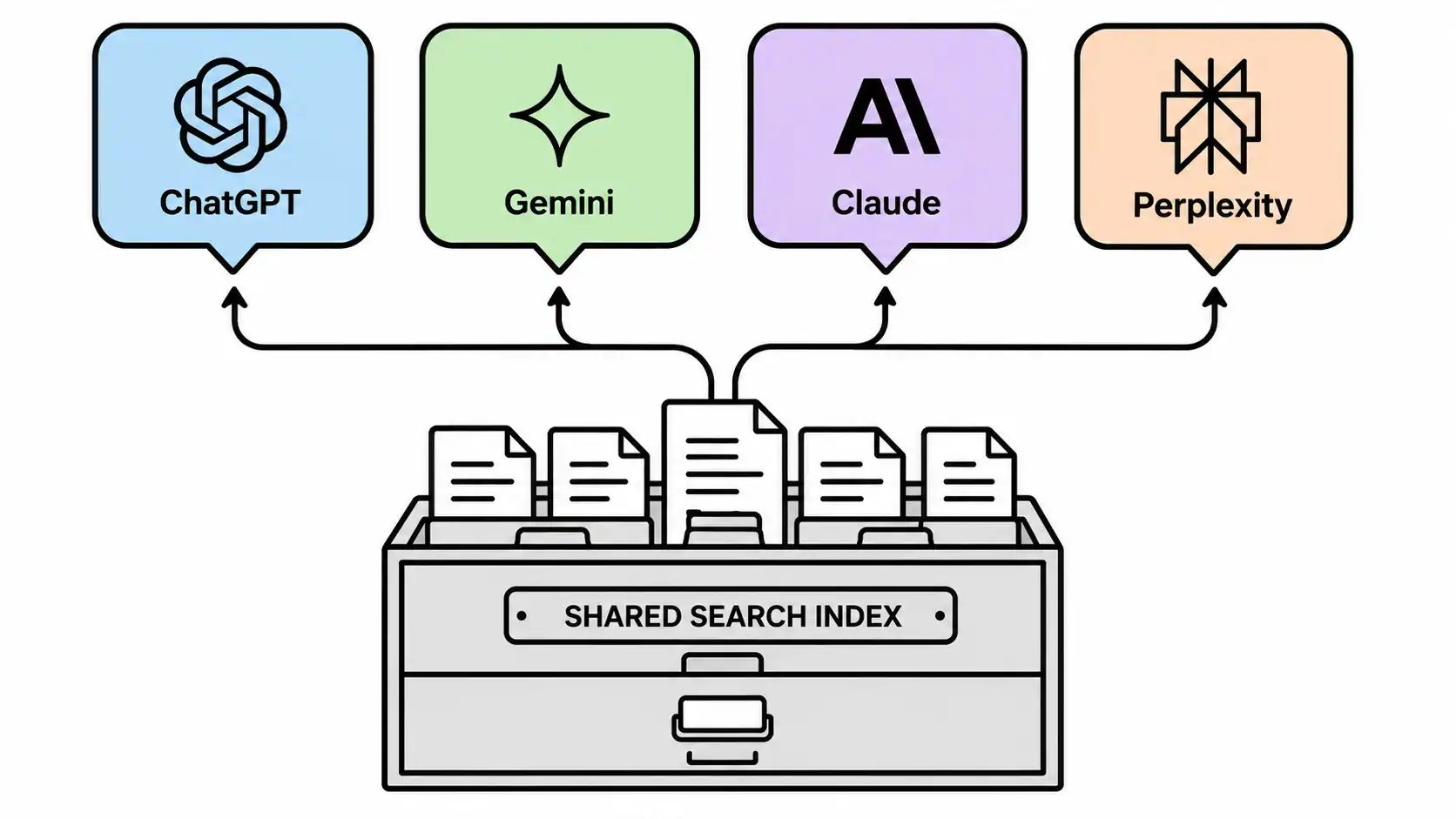
GEO is not separate from SEO. AI search engines (ChatGPT, Gemini, Claude, Perplexity) use traditional search indexes (Google, Bing, Brave) for real-time grounding. Better traditional SEO leads to better AI visibility. Most people treat them as different disciplines. They are not. They are the same foundation with a different consumption layer on top.
I have spent months running GEO tracking experiments across four AI engines and building visibility.so’s AI visibility engine. This guide is the technical layer underneath all of that: how these engines actually decide what to cite, and what you can do about it.
The Core Principle: AI Search Is Built on Traditional Search
Here is the mental model that changes everything: AI search engines do not maintain their own index of the web. They borrow one.
When you ask ChatGPT a question that needs current information, it does not reason from its training data alone. It runs a live search against Bing or Google, retrieves results, and grounds its answer in what it finds. The same is true for Gemini (Google index), Claude (Brave index), and Perplexity (its own index).
This means:
- Traditional SEO is not obsolete. It is the foundation AI engines retrieve from
- A page that is not crawlable and indexable on Google is invisible to most AI engines
- Technical SEO problems (blocked crawling, poor indexing, slow pages) hurt GEO exactly as much as they hurt Google rankings
The ranking model for both looks like this:
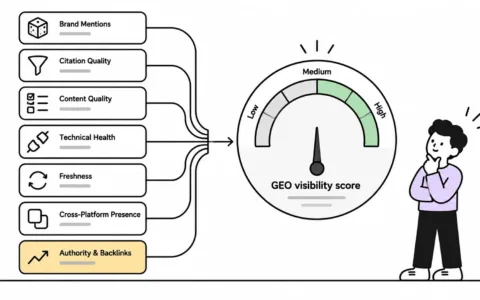
Visibility = f(Technical SEO + Content Quality/EEAT + Backlinks + User Signals)
AI engines do not skip any of these. They consume the output of the same signals through a different pipeline.
How the AI Search Pipeline Works
Strip away the marketing and every AI search engine runs the same pipeline:
- User prompt – the user types a conversational question
- Query fan-out – the engine decomposes the prompt into multiple shorter keyword-style queries
- Web search – each fan-out query hits a traditional search index (Google, Bing, or Brave)
- Retrieval and chunking – the engine pulls snippets, not full pages
- Grounding/RAG – the snippets are injected into the model’s context window
- Synthesis – the LLM generates an answer from the retrieved content
- Citations – sources are attributed
Each step is a place where your content either wins or loses.
The Search Indexes Behind Each Engine
| AI Engine | Backend Index |
|---|---|
| ChatGPT | Bing, Google |
| Claude | Brave |
| Gemini | |
| Perplexity | In-house |
| Copilot | Bing |
| Google AI Mode |
This table has practical consequences. If your site is poorly indexed on Bing, ChatGPT and Copilot lose visibility even if you rank well on Google. If Brave does not have your content, Claude cannot cite you. Cross-index optimization is now part of AI visibility.
Query Fan-Out: The Step Most SEOs Miss
This is the most misunderstood part of AI search.
Users type long conversational prompts into ChatGPT: “What is the best SEO platform for a small agency that wants to automate audits?” The engine does not search for that sentence. It decomposes it into shorter keyword-style queries that look like traditional SEO keywords: “best SEO platform for agencies,” “automated SEO audit tools,” “SEO platform small agency.”
The implication is significant. Your existing keyword research already covers the fan-out space. The queries you track in Ahrefs or Semrush are the same queries the AI engine generates internally.
One data point that surprised me: only about 12% of cited links in AI answers appear in the Google top 10 for the original long prompt. But the fan-out queries are where traditional SEO wins. Your keyword rankings for the short queries feed directly into whether the AI engine retrieves you.
Practical takeaway: Do not create a separate “AI SEO” keyword set. Optimize the keywords you already track. The fan-out layer uses them.
Retrieval and Chunking: Why Your Content Must Survive Being Cut
Here is the part that breaks most content strategies.
AI engines do not read your full page. They grab snippets of 200 to 2,000 words through chunking. The engine takes your content, cuts it into pieces, and decides which piece answers the query.
This means a page can be excellent overall and still never get cited, because the specific chunk that answers the query is buried under navigation, background, or throat-clearing.
The chunking problem has a direct fix: every paragraph must be independently valuable. An LLM might grab only your third H2 section. If that section cannot stand alone, you lose the citation.
What makes an LLM cite you:
- Relevance – how directly your content contributed to a specific claim in the answer
- Freshness – how recent your source is
- Diversity – AI engines prefer citing multiple sources, not the same one repeatedly
Freshness deserves attention. In my 30-day GEO tracking experiment, ChatGPT showed a strong bias toward content published in the last 30-60 days. Old but authoritative content lost to newer pieces even from lower-authority domains. Content freshness is a GEO factor, not just a Google factor.
Training Data vs Grounding: Two Different Visibility Channels
AI engines have two ways of knowing about your brand:
Training data is the static snapshot of the web at model release. Entity-based SEO helps here: Knowledge Graph presence, schema markup, brand consistency across the web, Wikipedia and Crunchbase entries. If a model already “knows” your brand from training, it is more likely to mention you without needing to retrieve you.
Grounding/RAG is real-time web search at answer time. Traditional SEO helps here: rankings, backlinks, technical health. Current and relevant answers use grounding, not training data.
The practical implication: you need both. Entity signals make you known. Traditional SEO makes you retrieved. Most brands focus on one and ignore the other.
GEO-Exclusive Tactics (Not for Traditional SEO)
Some tactics only matter for AI visibility. These are the ones that do not show up in a traditional SEO checklist:
1. Redirect Hallucinated URLs
AI engines sometimes invent URLs that do not exist. When ChatGPT cites a made-up URL on your domain, set up a catch-all redirect (301) so those invented URLs resolve to your real pages. This recovers citations that would otherwise be dead links.
2. Structure for Chunkability
Front-load value in every section. Put the answer in the first sentence or two. Use informative H2 headings that contain the takeaway, not labels. “How visibility.so Automated 96% of Its Audits” beats “Introduction.” Make sure the first 50-100 words of each section work as a standalone summary.
3. Entity Optimization
Build consistent entity signals: schema.org markup (Organization, Product, Article, FAQPage), Knowledge Graph presence, consistent name/address/phone across the web, and brand co-occurrence alongside relevant entities. LLMs reason about entities, not keywords.
4. AI Crawler Accessibility
Check that AI crawlers are allowed. Cloudflare’s default settings and aggressive security layers block GPTBot, Claude-Web, PerplexityBot, and Google-Extended. Verify your robots.txt and security settings are not silently excluding the crawlers that feed AI engines.
A Chunking-Aware Content Model
The content structure that wins under AI retrieval looks different from the classic blog structure:
| Bad Structure | Chunking-Aware Structure |
|---|---|
| Intro | Title with key finding |
| Background | Summary/TL;DR |
| Industry overview | Key data table |
| Methodology | Main analysis |
| Answer | FAQ |
| Conclusion | – |
Every section must be self-contained. Headings should contain the answer, not describe the section. Tables for anything comparative. FAQ blocks that answer one question per block. This is the model we use across the content on sanjayshankar.me, and it is the model visibility.so’s content pipeline recommends to users.
What This Means for Your SEO Workflow
If you are an SEO professional, this changes three habits:
- Stop treating GEO as separate. It is traditional SEO plus an AI consumption layer. Fix the technical foundation first.
- Refresh content on a cycle. Freshness is a citation factor. Old posts need refresh schedules, not just new posts.
- Check your AI crawler access. A Cloudflare setting you configured years ago might be blocking every AI engine from reading your site.
Frequently Asked Questions
Do AI search engines use Google's index?
Some do. Gemini and Google AI Mode use Google. ChatGPT uses Bing and Google. Claude uses Brave. Perplexity maintains its own index. There is no single backend index across all engines.
Does ranking on Google help with AI visibility?
Yes. Most AI engines retrieve from traditional search indexes. Better Google rankings usually mean better retrieval, which means better AI visibility. The exceptions are engines with their own indexes like Perplexity.
What is query fan-out?
Query fan-out is how AI engines decompose a long conversational prompt into multiple shorter keyword-style queries before searching. Your existing keyword research covers this space, which is why traditional SEO still matters.
Why do AI engines cite some pages and not others?
Relevance to the specific claim, freshness of the source, and citation diversity. Engines prefer multiple sources, so being one of several is better than being the only one.
How long are the content snippets AI engines use?
Roughly 200 to 2,000 words per chunk. Your content must be valuable in isolation because the engine may only use one section of your page.
Does llms.txt help AI engines find content?
It can help. llms.txt provides a structured summary of your site for AI systems that choose to consume it. See our llms.txt guide for a full walkthrough.
How is this related to agentic SEO?
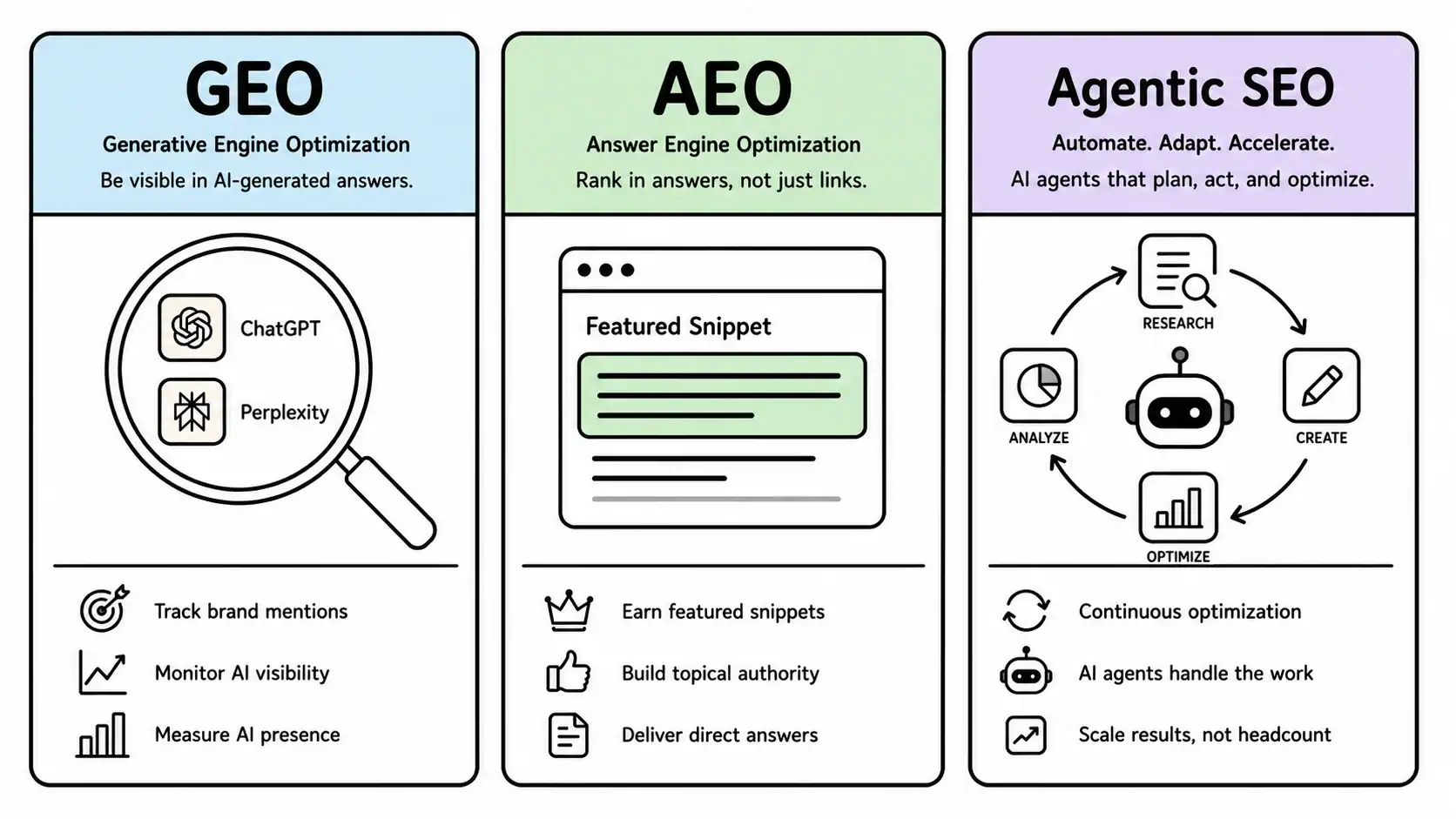
Agentic SEO is the operating model that runs visibility tracking, opportunity discovery, and execution continuously. Understanding how AI engines work is the technical foundation for agentic SEO.
Found this useful? Share it with someone still treating GEO and SEO as separate disciplines. Follow @sanjayshankarr for more on AI search mechanics.