Quick answer: GEO (generative engine optimization) works by making your brand retrievable and quotable inside AI answers. AI engines decompose user prompts into multiple search queries, retrieve content from traditional search indexes, cut it into short chunks, and decide which sources to cite based on relevance, freshness, and diversity. GEO is not a separate ranking system – it is traditional SEO plus an AI consumption layer on top.
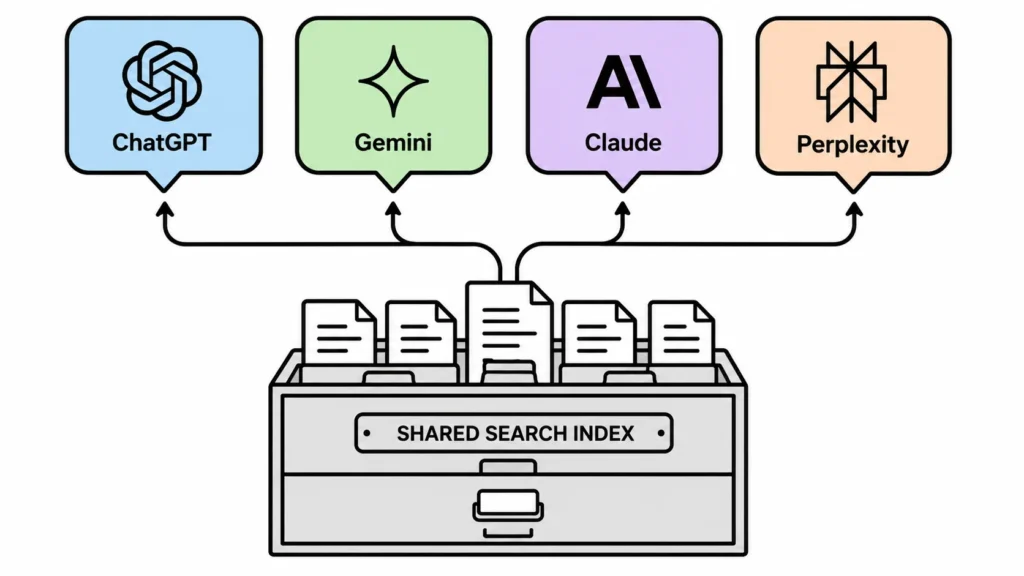
I have spent months running GEO tracking experiments across four AI engines, and I built visibility.so’s AI visibility engine to automate this exact measurement. This guide is the mechanics layer: how the retrieval pipeline works, what makes an engine cite you, and the levers you can actually pull.
The GEO Pipeline: What Happens Between Prompt and Answer
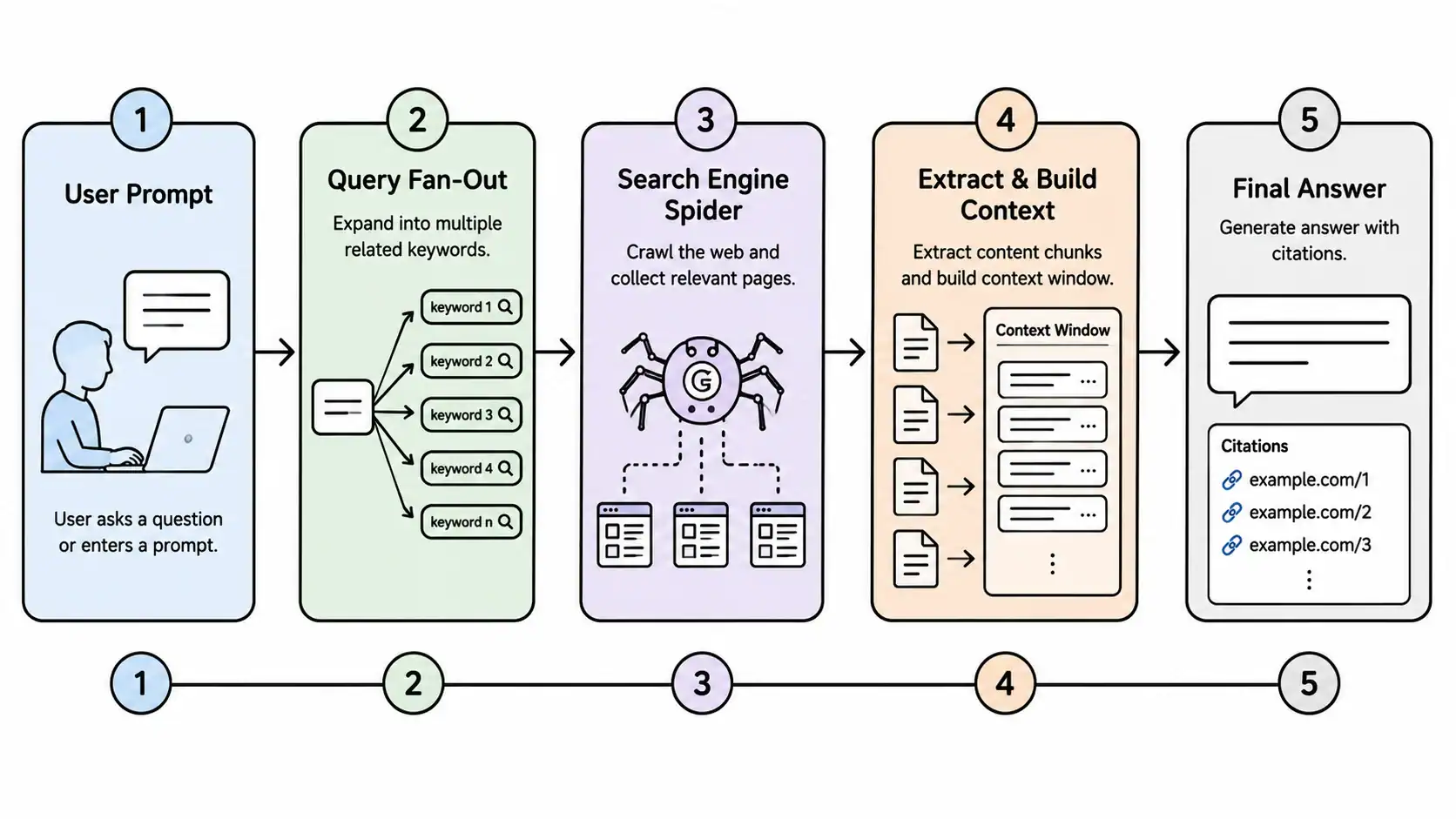
Every GEO outcome is decided inside a five-step pipeline. Understanding each step tells you where you win and where you lose.
- Prompt decomposition – the user’s conversational question is broken into shorter keyword-style queries
- Web retrieval – each query hits a traditional search index (Google, Bing, or Brave) through RAG
- Chunking – retrieved pages are cut into snippets of roughly 200 to 2,000 words
- Grounding – the snippets are injected into the model’s context window
- Synthesis with citations – the LLM writes the answer and attributes sources
For the full detail on steps 1 and 2, see how AI search engines work. The rest of this guide focuses on the steps where you have the most control: chunking, grounding, and citation decisions.
What Makes an LLM Cite You
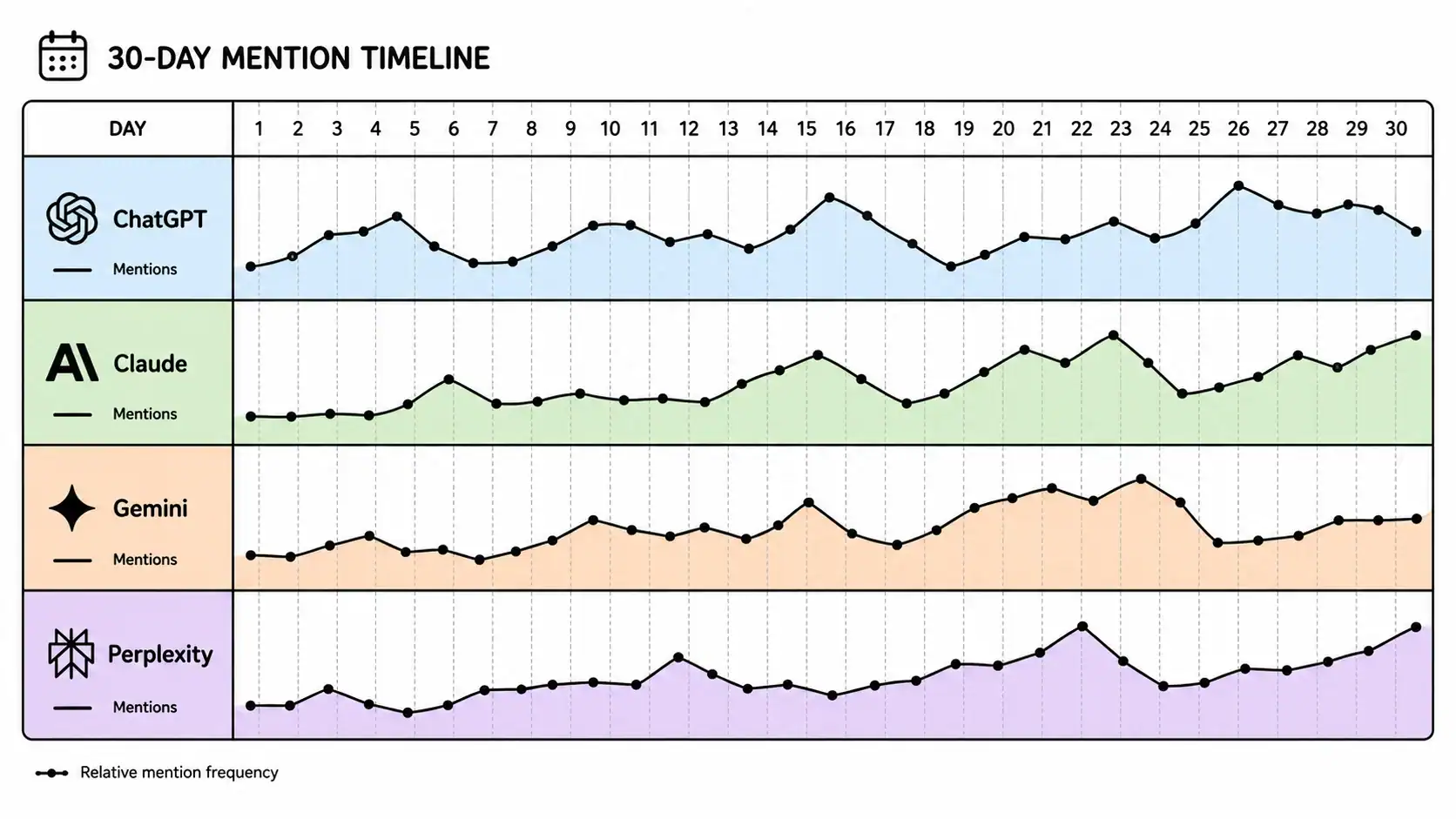
Across my tracking, three factors dominate citation decisions. In our 30-day GEO tracking experiment, we observed all three in action:
1. Relevance: How Directly Your Content Answers the Claim
AI engines cite sources that contributed to a specific claim in the answer. A page that covers your topic broadly but never states the exact answer gets passed over. The winning pages state the answer clearly and early, in the first sentence or two of a section. Google’s own AI Overviews documentation describes a similar relevance-first approach for AI-generated search answers.
In our tracking: pages with the answer in the first 50-100 words were cited far more than pages that built context first. Context-heavy introductions are citation killers.
2. Freshness: How Recent Your Source Is
Freshness carries more weight in AI retrieval than in traditional search. In our experiment, ChatGPT showed a bias toward content published in the last 30-60 days. Old but authoritative pages lost to newer pieces, even from lower-authority domains.
“Content freshness correlated with higher citation rates in our tracking. The oldest cited source in our data was under 90 days old.” – Sanjay Shankar, from the GEO tracking experiment
3. Diversity: How Many Sources Engines Prefer
AI engines prefer citing multiple sources rather than one repeatedly. Being the second or third source in an answer is a win – you do not need to be the only source. This lowers the bar: being consistently relevant and fresh across several queries matters more than being dominant on one.
The Chunking Problem: Your Content Is Cut Before It Is Read
Here is the part that breaks most content strategies: AI engines do not read your full page. They grab chunks of 200 to 2,000 words and decide which chunk answers the query.
This means a page can be excellent overall and still never get cited, because the specific chunk that answers the query is buried under navigation, background, or throat-clearing.
The fix is structural: every paragraph must be independently valuable. If the engine grabs only your third H2 section, that section must work as a standalone answer. Our full chunking-aware content model covers the exact structure.
Entity Signals: Making Engines “Know” Your Brand
Beyond retrieval, AI engines also reason about entities. Entity-based SEO makes your brand legible as a thing – a company, a product, a person – rather than just text on a page.
The entity signals that matter:
| Signal | What It Does | Where It Lives |
|---|---|---|
| Schema markup | Tells engines what your page is about | Organization, Product, Article, FAQPage |
| Knowledge Graph presence | Makes engines recognize your brand as an entity | Google Knowledge Graph, Wikipedia, Crunchbase |
| Consistent NAP | Name, address, phone consistency across the web | Directories, listings, profiles |
| Brand co-occurrence | Your brand appearing alongside relevant entities | Content, press, listings |
Why this matters for GEO: Entity signals represent an LLM’s memory layer (parametric training data), while web retrieval is its live layer (non-parametric RAG). A model that already “knows” your brand from training is far more likely to cite you during live synthesis. Winning AI visibility requires optimizing both layers together. Google’s Search Central documentation on structured data is the best starting point for implementing schema correctly.
GEO-Exclusive Tactics (Not for Traditional SEO)
Some tactics only matter for AI visibility. These do not show up in a traditional SEO checklist:
1. Redirect Hallucinated URLs
AI engines sometimes invent URLs that do not exist. When ChatGPT cites a made-up URL on your domain, set up a catch-all redirect (301) so those invented URLs resolve to your real pages. This recovers citations that would otherwise be dead links.
2. Structure for Chunkability
Front-load value in every section. Put the answer in the first sentence or two. Use informative H2 headings that contain the takeaway, not labels. “How visibility.so Automated 96% of Its Audits” beats “Introduction.”
3. Answer Capsules for RAG Retrieval
Put a bold 50-word summary (an answer capsule) directly under your H1. Retrieval systems and LLMs consistently surface these compact summaries when answering questions about your topic. We use this pattern across every post on this site.
4. AI Crawler Accessibility
Check that AI crawlers are allowed. Cloudflare’s default settings and aggressive security layers block GPTBot, Claude-Web, PerplexityBot, and Google-Extended. Verify your robots.txt and security settings are not silently excluding the crawlers that feed AI engines.
How to Measure GEO: The Tracking Loop
You cannot optimize what you cannot see. The measurement loop has three parts:
- Baseline – run your prompts against all four engines, record mentions and citations
- Track over time – schedule regular checks to see score trends per engine
- Correlate with actions – publish content, fix crawl issues, then watch whether citations improve
This is exactly the loop we built into visibility.so’s AI visibility engine. It runs prompts against ChatGPT, Claude, Gemini, and Perplexity on a schedule, detects brand and competitor mentions, and scores visibility over time.
Challenges and How to Fix Them
Challenge: You rank top 5 on Google but AI engines never mention you.
Example: A client site ranking #3 for its target keyword, yet zero mentions across 30 days of tracking across four engines.
Fix: Check AI crawler access first. Cloudflare defaults block GPTBot and PerplexityBot silently. In our experience, fixing crawler access alone restored citations within two weeks. Then check chunkability: if your answer is buried 800 words into the page, restructure it into the first section.
Challenge: Citations appear, then disappear.
Example: A brand cited consistently for three weeks, then vanished from answers for two.
Fix: Freshness is the likely culprit. Your cited content aged past the freshness window while a competitor published newer content. Refresh the content with updated data, republish, and track again.
Challenge: You are cited, but only as a link in a list.
Example: The engine mentions your brand in a “related tools” list, but never quotes your actual claims.
Fix: This means retrieval found you but chunking chose a weak piece. Restructure your content so the strongest claim sits in its own short section with an informative heading. The engine needs a clean, quotable chunk to cite.
Challenge: Competitors dominate every AI answer.
Example: A competitor is cited in 60% of answers for your shared keywords; you appear in 5%.
Fix: Compare entity signals. If the competitor has Knowledge Graph presence, schema, and consistent listings and you do not, that gap compounds across engines. Build the entity layer first, then layer freshness with regular content updates.
Frequently Asked Questions
Is GEO the same as SEO?
No. GEO is generative engine optimization – optimizing for mentions and citations inside AI answers. It is built on top of traditional SEO: AI engines retrieve from traditional indexes. You need both.
How long does GEO take to show results?
In our tracking, citations started appearing within 2-4 weeks after fixing crawl access and structuring content for chunking. Entity signals take longer, typically 2-3 months to compound.
Which AI engine should I optimize for first?
Start with the one your customers actually use. In our tracking, ChatGPT and Perplexity were the most active at citing web sources. Gemini and Claude leaned more on training data. Measure all four, optimize where your audience lives.
Does fresh content really matter for GEO?
In our experiment, yes. ChatGPT showed a bias toward content published in the last 30-60 days. Old authoritative pages lost to newer pieces. Refresh content on a cycle, not just when you publish something new.
What is the difference between GEO and AEO?
AEO (answer engine optimization) targets getting your content extracted as a clean direct answer. GEO targets brand mentions and citations across AI answers. See our GEO vs AEO vs Agentic SEO breakdown for the full comparison.
Does schema markup help AI engines?
Yes. Schema markup (Organization, Product, Article, FAQPage) makes your content legible as structured entities. LLMs reason about entities, so structured data improves both understanding and citation likelihood.
How is GEO different from agentic SEO?
GEO is the outcome – being cited in AI answers. Agentic SEO is the operating model – using AI agents to run visibility tracking, opportunity discovery, and execution continuously. See what agentic SEO actually means.
Conclusion
GEO works through a five-step pipeline: prompt decomposition, web retrieval, chunking, grounding, and citation synthesis. The levers you control are relevance, freshness, chunkability, entity signals, and crawler access. Measure with a tracking loop, fix the technical layer first, then compound with content freshness. The brands winning AI visibility today are the ones treating GEO as a measurable system, not a buzzword.
Next step: read the technical pillar on how AI search engines work for the retrieval mechanics, or see our GEO tracking experiment for the 30-day data behind these patterns.
Found this useful? Share it with someone still treating GEO as a mystery. Follow @sanjayshankarr for more on AI visibility mechanics.