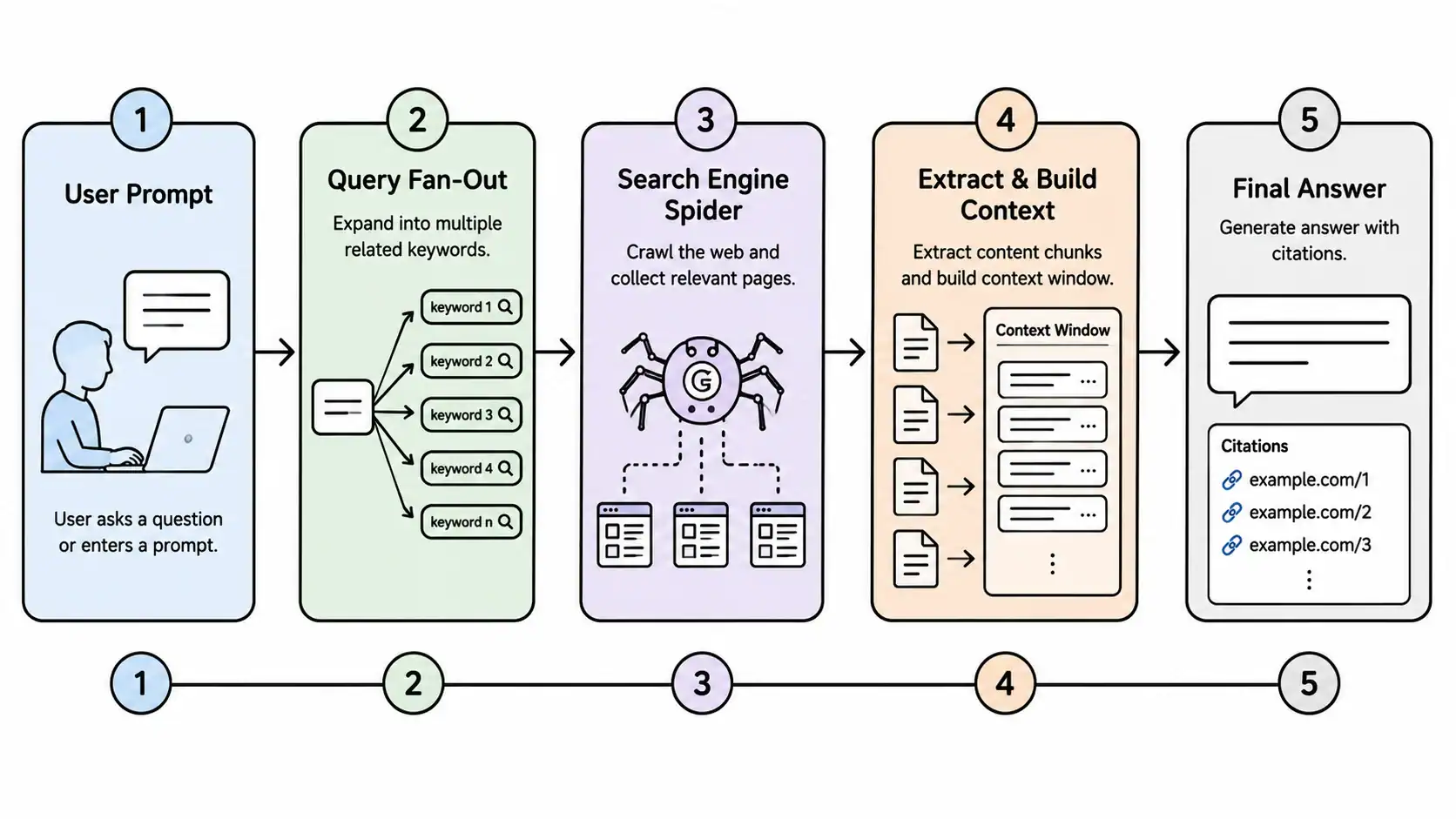
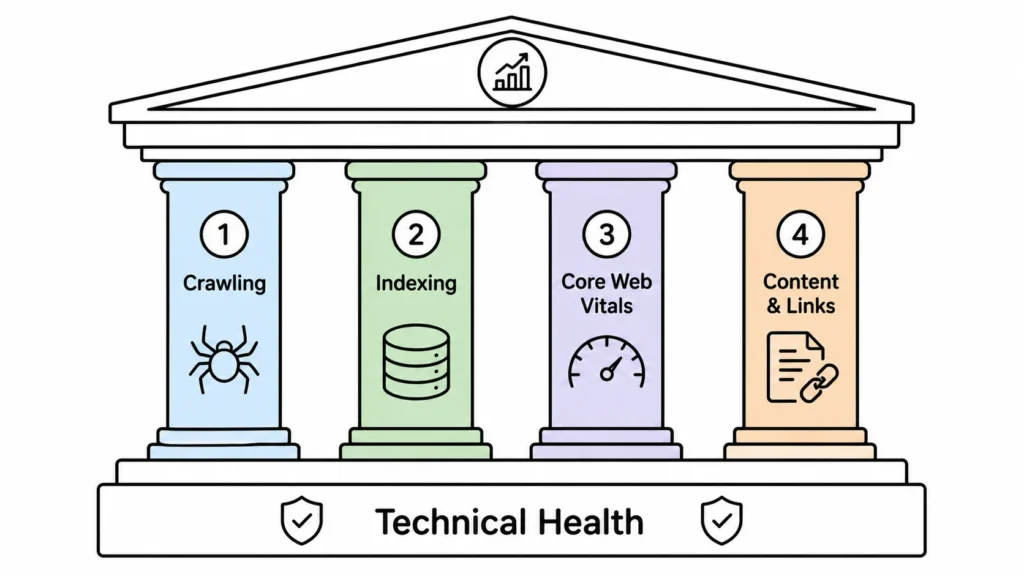
Quick answer: Traditional SEO works through four pillars: crawling (can search engines find your pages), indexing (can they store and understand them), Core Web Vitals (does your site perform well enough to deserve ranking), and content plus links (does the market consider you authoritative). AI search engines consume the output of these same pillars. If you get them wrong, you are invisible everywhere – on Google, ChatGPT, and Perplexity alike.
I have spent the last decade-plus managing SEO-driven products, and I built visibility.so’s audit agents to run these checks on a schedule. Every AI visibility problem I have seen traces back to a traditional SEO failure underneath. This guide breaks down how the machine works, what breaks, and what to fix first.
Pillar 1: Crawling – Can Search Engines Find Your Pages?
Crawling is the discovery stage. Search engines send bots to your site to read pages and follow links. If a page cannot be crawled, it might as well not exist.
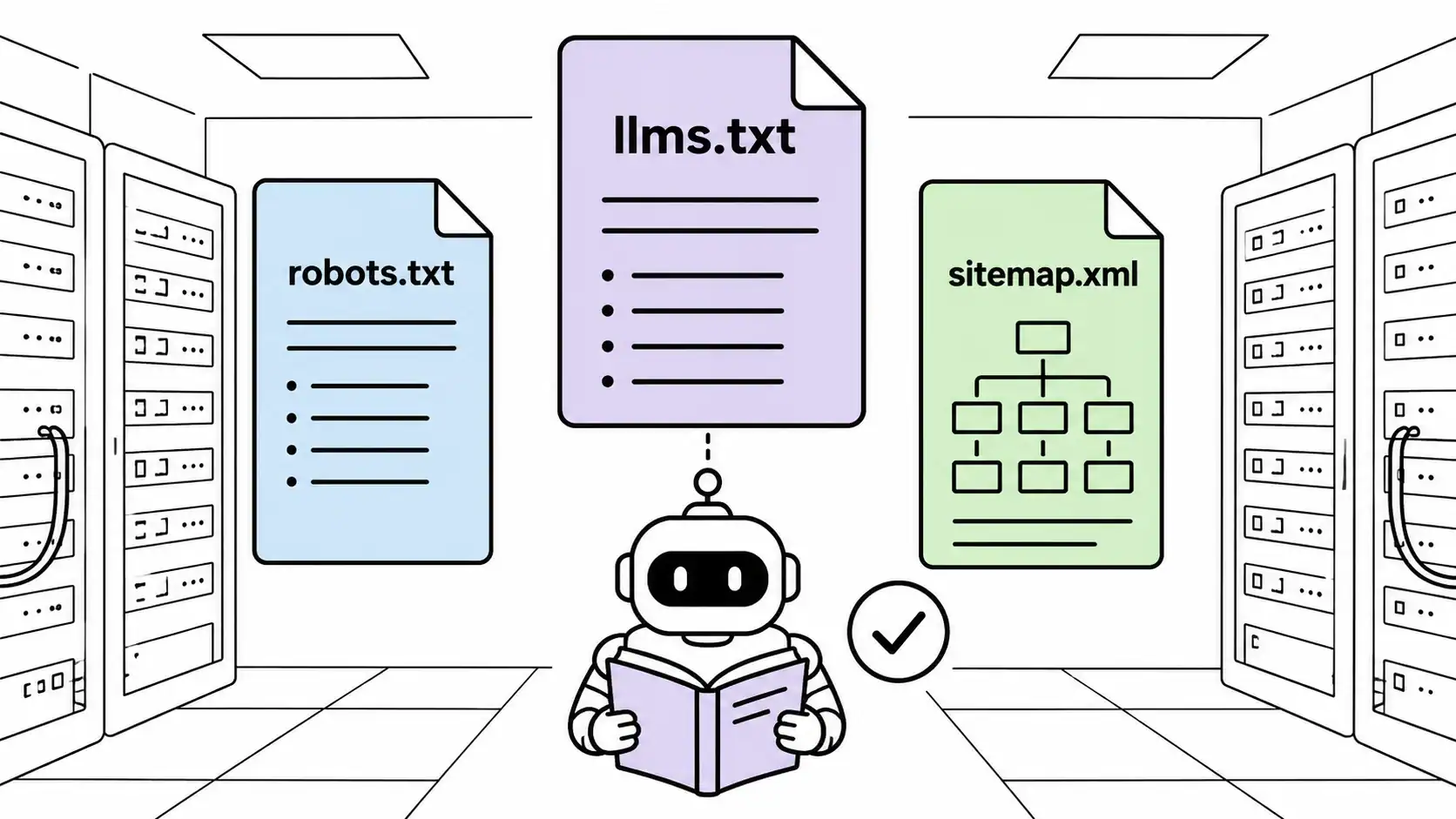
Three files control crawling:
| File | Purpose | Where It Lives |
|---|---|---|
| robots.txt | Directs crawlers where they can and cannot go | /robots.txt |
| Sitemap | Lists the pages you want indexed | /sitemap.xml |
| Crawl budget | How often Google actually crawls you | GSC → Crawl Stats |
The AI twist: Most LLM crawlers do not render JavaScript. If your critical content loads only through JavaScript, AI engines may never see it. Keep important content in static HTML or server-rendered pages. I have seen this single mistake hide entire sites from AI visibility.
Quick win: Open your GSC crawl stats. If Google is crawling fewer pages than you have, something is blocking discovery – likely robots.txt rules, internal link issues, or redirect chains.
Pillar 2: Indexing – Can Search Engines Understand Your Pages?
Indexing is the storage stage. The search engine decides what your page is about and files it for retrieval. A crawled page that is not indexed ranks nowhere.
The common indexing controls:
- Robots meta tag –
<meta name="robots" content="noindex" />tells engines to skip a page - Canonical tags – declare the preferred version when duplicate content exists
- Internal links – help engines discover and prioritize pages
- Redirects – consolidate signals from old URLs to new ones
The AI twist: Indexed pages feed directly into AI retrieval. Gemini uses the Google index. ChatGPT uses Bing and Google. If your page is not indexed in the right index, the corresponding AI engine cannot cite you. This is why we track AI visibility across engines – each engine reads a different index.
Quick win: Use GSC’s URL Inspection tool on your top 10 pages. It shows exactly how Google indexed each one and flags issues you can fix immediately.
Pillar 3: Core Web Vitals – Does Your Site Deserve to Rank?
Core Web Vitals measure the real-world experience of loading your site. Google uses them as ranking signals, and they have not gone away.
| Metric | What It Measures | Good Target |
|---|---|---|
| LCP | Visual load speed | ≤ 2.5 seconds |
| CLS | Visual stability (layout shifts) | ≤ 0.1 |
| INP | Interactivity (response to clicks) | ≤ 200ms |
Core Web Vitals are defined and documented by Google in the official Core Web Vitals guide. The targets above match Google’s published thresholds.
Plus: HTTPS, mobile-friendly design, and no intrusive interstitials.
The AI twist: Slow, unstable pages get retrieved less because they fail the quality bar in the index. A page that is technically broken rarely wins citations, even when the content is strong.
Quick win: Run a speed test on your top 5 pages. The three most common fixes are image compression, removing render-blocking scripts, and fixing layout shift by reserving space for images and ads.
Pillar 4: Content and Links – Does the Market Consider You Authoritative?
The first three pillars get you into the game. Content and links decide whether you win.
Content quality/EEAT: Expertise, experience, authoritativeness, and trust. Search engines look for content that demonstrates firsthand knowledge, not reworded articles.
Backlinks: Links from other sites are votes of confidence. They remain a core ranking signal in 2026.
User signals: Click-through rate, time on page, and bounce rate tell engines whether searchers found what they wanted.
The AI twist: AI engines use these same signals through their retrieval layer. Our technical SEO reference shows how rankings, freshness, and entity signals feed directly into what AI engines cite.
Quick win: Look at your top 5 ranking pages. Does each one have at least one strong internal link, one credible external link, and a clear answer in the first paragraph? If not, fix those first.
The Quick Wins That Move the Needle First
If you are starting from scratch, do these in order:
- Check indexing status – GSC URL Inspection or a site audit. Find pages that are not indexed and fix them
- Reclaim lost links – find 404 pages that still have backlinks and 301-redirect them to live pages
- Fix internal linking – add contextual links between your pages, not just navigation links
- Add schema markup – structured data helps Google AND LLMs understand your content. Google’s structured data documentation covers the main types and how to implement them
This order matters. Indexing first (why no one finds you), then links (what you are losing), then internal flow (what pushes ranking), then schema (what improves understanding).
Challenges and How to Fix Them
Challenge: You publish regularly but pages do not get indexed.
Example: A team publishing 10 posts a month sees only 2 in Google’s index after 8 weeks.
Fix: Check the robots meta tag and sitemap submission. In my experience, the fix is usually a noindex tag left on by a plugin or a sitemap that was never submitted to GSC. Fix both, then request reindexing of the priority pages.
Challenge: Rankings exist but clicks are flat.
Example: A page ranks number 3 for its target keyword but gets a 1% CTR.
Fix: The title and meta description do not match search intent. Rewrite the title to mirror how searchers phrase the query, and put the answer in the first 50 words of the page. Click-through follows intent match.
Challenge: Traffic drops suddenly after an update.
Example: Impressions halve overnight following a Google core update.
Fix: Do not panic-rewrite. Compare your lost queries against what changed in the update. Usually the fix is content freshness – the losing pages are older than newer competitors. Refresh the content with updated data and republish.
Challenge: AI engines never mention your brand.
Example: You rank top 5 on Google but ChatGPT cites a competitor every time.
Fix: This is a retrieval layer problem. Check how AI search engines work and verify AI crawlers are not blocked. Cloudflare defaults and aggressive security settings silently block GPTBot and PerplexityBot. Fix access first, then audit content chunkability.
Frequently Asked Questions
Does traditional SEO still matter if AI search is growing?
Yes. AI engines retrieve from traditional search indexes. Technical SEO problems hurt AI visibility exactly as much as Google rankings. GEO is not separate from SEO – it is built on top of it.
What are the most important technical SEO factors in 2026?
Crawling access, indexing coverage, Core Web Vitals, and structured data. These four determine whether engines can find, understand, and trust your pages.
Is Core Web Vitals still a ranking factor?
Yes. LCP, CLS, and INP remain ranking signals. They also affect AI retrieval indirectly, because technically broken pages rarely win citations.
How often should I run a technical SEO audit?
Monthly for most sites. Weekly if you publish frequently or have a large site. The audit should check indexing, crawl errors, Core Web Vitals, and internal linking.
Do backlinks still matter in 2026?
Yes. Backlinks remain a core authority signal. AI engines inherit this signal through their retrieval layer, so link building still pays off for AI visibility too.
How does traditional SEO connect to AI visibility?
AI engines like Gemini and ChatGPT pull from traditional indexes. Better crawlability, indexing, and authority mean better retrieval, which means better AI citations. See how AI search engines work for the mechanics.
What should I fix first – SEO or GEO?
Fix traditional SEO first. AI visibility is layered on top of it. If your pages are not crawlable and indexed, no amount of GEO optimization will make AI engines cite you.
Conclusion
Traditional SEO works through four pillars: crawling, indexing, Core Web Vitals, and content with links. AI search engines consume the output of these same pillars through their retrieval layer. Fix the foundation first, then layer AI visibility on top. The quick wins – indexing checks, lost link redirects, internal linking, and schema – take days, not months, and they move both Google rankings and AI citations.
Next step: If you want to understand the retrieval layer these pillars feed into, read how AI search engines work. And if you want these audits run automatically on a schedule, visibility.so does exactly that with its audit agents.
Found this useful? Share it with someone still asking whether SEO is dead. Follow @sanjayshankarr for more on SEO mechanics and AI search.