GEO vs AEO vs Agentic SEO are three different answers to three different questions. Understanding GEO vs AEO vs Agentic SEO is essential if you are investing in AI search visibility.
Here is what each one actually means and how they work together.
I get some version of this question every couple of weeks now, usually in a LinkedIn DM: “Is agentic SEO just a new name for GEO?” or “Isn’t AEO the same thing as what you are calling agentic SEO?”
No, no, and no. But I understand why people ask. All three terms appeared within the same 18-month window. All three are reactions to AI changing how people search. And marketing content being what it is, a lot of writers use them interchangeably to sound current.
They are not interchangeable. They answer three different questions about three different problems.
Quick answer:
- GEO (Generative Engine Optimization) — will an AI chatbot mention my brand when it answers a question?
- AEO (Answer Engine Optimization) — is my content structured so an answer engine can lift a clean answer out of it?
- Agentic SEO — is the whole process of tracking, prioritizing, and fixing all of the above running on autopilot, or am I doing it by hand?
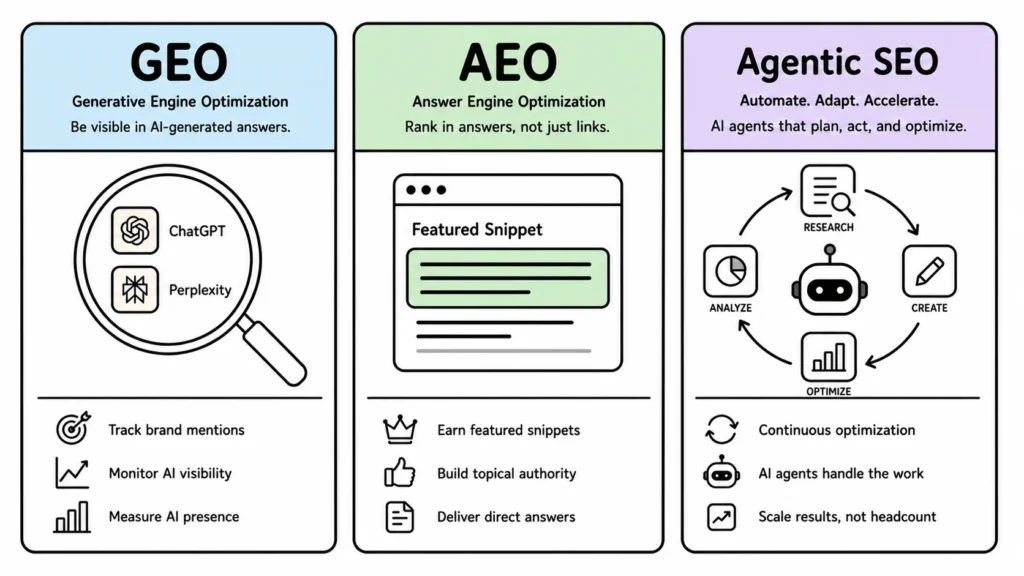
If you only remember one sentence: GEO and AEO describe what you are optimizing for. Agentic SEO describes how the work gets done.
Understanding GEO vs AEO vs Agentic SEO: Three Different Questions
1. GEO: Generative Engine Optimization
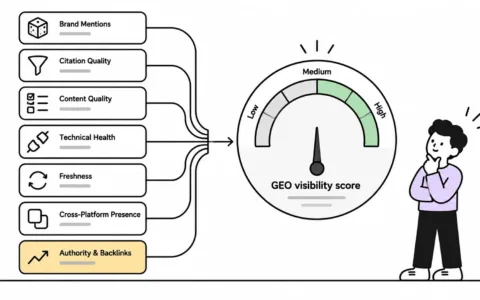
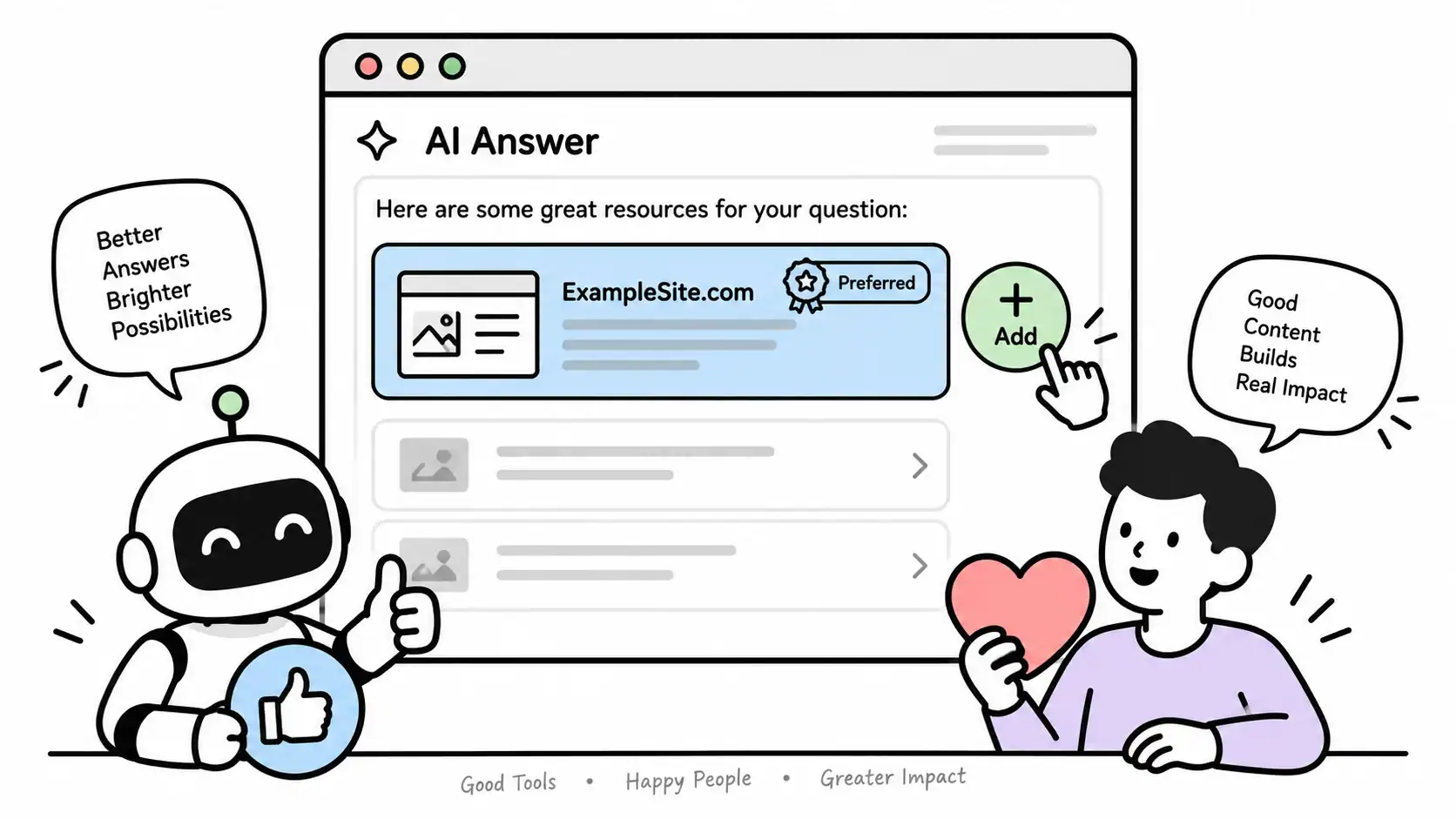
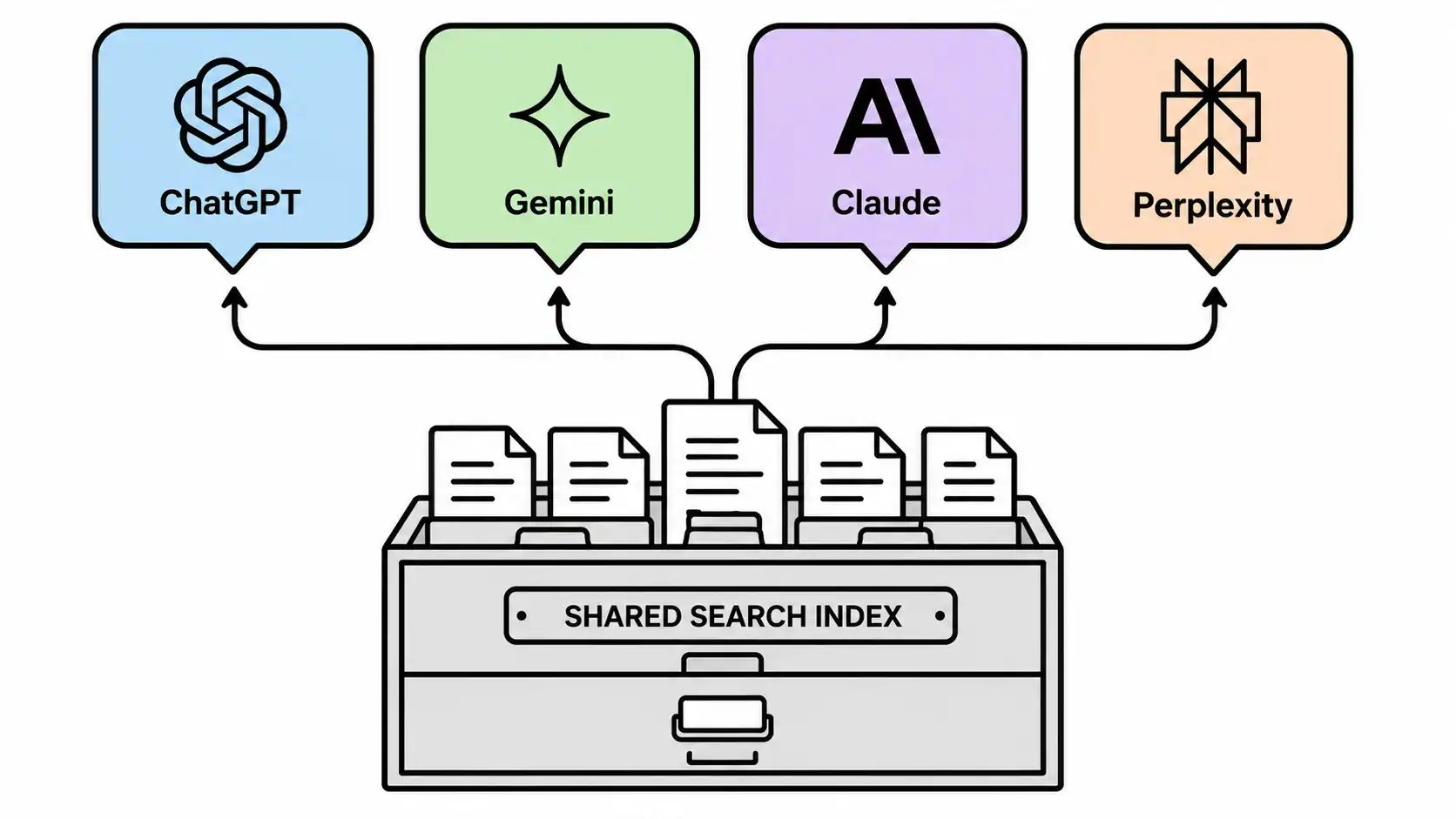
GEO is about visibility inside generated answers. When someone asks ChatGPT, Gemini, Perplexity, or Google’s AI Overviews a question in your space, does your brand get named? Cited? Linked? Or does the answer skip you entirely and cite a competitor?
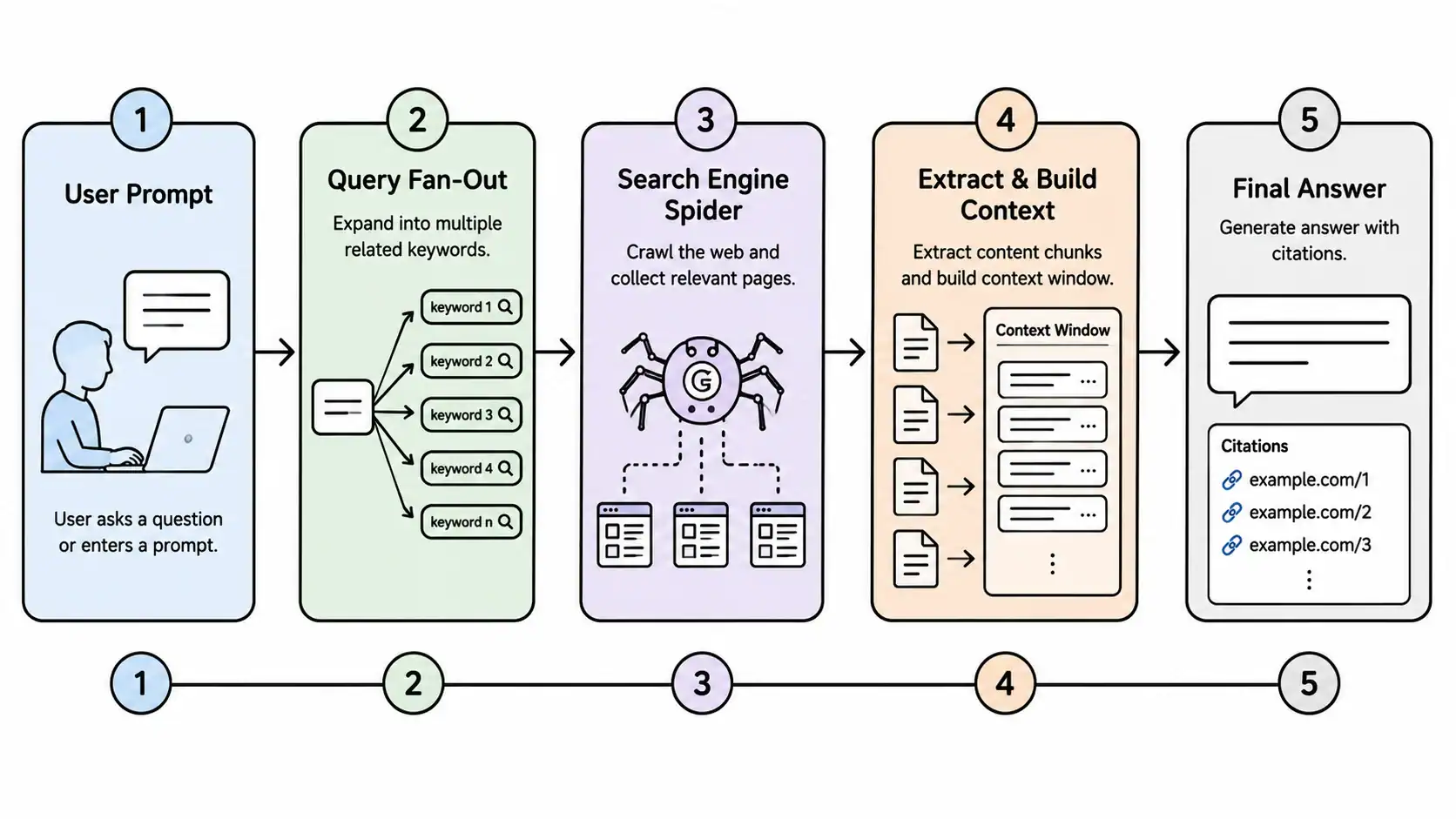
This is a genuinely new problem, not a rebrand of an old one. A page can rank number one on Google and still never get mentioned in an AI-generated answer. The model is synthesizing from dozens of sources and deciding which ones are worth naming. GEO is the practice of earning that mention: being clear, being consistent across the web, and being the source a model already knows rather than one it has to gamble on.
I ran a 30-day GEO tracking experiment across four AI engines on this exact question. Worth a read if you want to see what tracking AI mentions actually looks like week to week rather than as a one-time check.
For the mechanics of how engines retrieve and cite, see how AI search engines work.
2. AEO: Answer Engine Optimization
AEO is a content structuring discipline. It is about writing so that a featured snippet, a voice assistant, or an AI summary can pull a clean, self-contained answer out of your page without misquoting or flattening it.
In practice, this means: a direct answer in the first sentence or two of a section, not three paragraphs of throat-clearing first. Clear H2 and H3 headers that match how people phrase the question. FAQ blocks that answer one question per block. Tables for anything comparative. Schema markup that tells the crawler what it is looking at.
AEO existed in a rougher form before “AEO” was a term. It is the evolution of writing for featured snippets, applied to a wider set of answer surfaces. One of the more overlooked levers here is telling AI crawlers directly what your site contains and how to use it, which is what an llms.txt file does. It is a small technical step that supports the same goal as good AEO writing.
3. Agentic SEO
Agentic SEO is not a content discipline at all. It is an operating model. It is the practice of using AI agents to run SEO as a continuous loop: monitor rankings and AI visibility, find opportunities, turn them into tasks, execute the fixes, measure what happened, and repeat. Automatically, instead of waiting for next quarter’s audit deck.
This is the term most people get wrong, because they hear “agentic” and assume it means “AI wrote the content.” That is not it.
Agentic SEO is about who or what runs the workflow. A research agent flags a page losing impressions. A strategy agent decides it needs a new FAQ section. A content agent drafts it. A QA agent checks it. A monitor agent watches whether it worked. A human approves before anything ships.
GEO and AEO can both be outputs of that loop. They are what the agents are optimizing for. Agentic SEO is the system that gets the optimizing done.
At visibility.so, we built the platform specifically for this model. AI agents handle monitoring, auditing, and task creation. Humans approve, guide, and set strategy. It turns the loop I described above into something you can set up in minutes rather than building from scratch.
GEO vs AEO vs Agentic SEO Comparison Table
| GEO | AEO | Agentic SEO | |
|---|---|---|---|
| Full name | Generative Engine Optimization | Answer Engine Optimization | Agentic SEO (no expansion — “agentic” describes the execution model) |
| Core question | Does AI mention my brand? | Can AI extract a clean answer from my page? | Who or what is doing the ongoing SEO work? |
| What you optimize | Brand presence and citation frequency in AI-generated answers | Content structure: headers, FAQs, direct answers, schema | The workflow: monitoring, prioritization, execution, measurement |
| Where it shows up | ChatGPT, Perplexity, Gemini, AI Overviews | Featured snippets, voice answers, AI summaries | Everywhere above — it is the process, not a channel |
| How you measure it | Citation rate across AI engines | Snippet capture, answer box appearances | Task completion rate, time to fix, whether the loop actually closes |
| Is it a replacement for traditional SEO? | No — layered on top | No — layered on top | No — it is how traditional SEO, GEO, and AEO actually get executed at scale |
Traditional SEO still matters — here’s how it works.
How GEO vs AEO vs Agentic SEO Overlap (Because They Do)
None of these live in separate silos. A single well-structured page can serve all three at once:
- Clean, extractable structure earns AEO wins (snippet placement)
- Consistent, well-sourced information earns GEO wins (AI citations)
- If an agent pipeline is the one finding the gap, writing the fix, and checking whether it worked — that is agentic SEO, regardless of whether the output happens to be a GEO win or an AEO win
The useful way to think about GEO vs AEO vs Agentic SEO: GEO and AEO are targets. Agentic SEO is the engine that hits them repeatedly instead of once.
Which One Should You Focus On First in GEO vs AEO vs Agentic SEO?
Start with GEO if
AI tools rarely mention your brand for questions you should own. Pick 5-10 prompts your customers would realistically type into ChatGPT or Perplexity. Check monthly whether you are named. Fix the content gaps that show up.
Start with AEO if
You already rank but keep losing the featured snippet or the AI Overview to a competitor with a worse page. Restructure your best pages: answer up top, clear headers, FAQ block, comparison table where it fits.
Start with Agentic SEO if
You know what needs fixing but nothing ever gets fixed because it is stuck in a spreadsheet nobody opens. That is not a GEO or AEO problem. It is an execution problem, and it is what agentic SEO exists to solve.
Most sites need all three eventually. Almost none need all three on day one.
Frequently Asked Questions
Is GEO the same as AEO?
No. GEO is about being mentioned inside AI-generated answers (brand visibility). AEO is about your content structure being clean enough for an answer engine to extract a direct answer. A page can win at one and not the other.
Is agentic SEO just AI-generated content?
No. Agentic SEO is about automating the workflow around SEO (research, prioritization, execution, monitoring), not about who or what writes the words. Human review still belongs in the loop before anything publishes.
Do I need to pick one of these three?
No. They are not competing strategies. GEO and AEO are outcomes you are optimizing for. Agentic SEO is the system that keeps optimizing for them without you manually re-running the process every month.
Does ranking well on Google still matter if I am focused on GEO or AEO?
Yes. Traditional SEO fundamentals (technical health, content quality, backlinks) are still the foundation all three of these sit on top of. None of these terms describe a replacement for good SEO. They describe new surfaces and new execution methods layered on it.
What is the fastest way to tell if I have a GEO problem?
Ask ChatGPT, Perplexity, and Gemini a handful of questions your customers would ask in your actual product category and see if you get named. If a competitor comes up every time and you never do, that is your answer. It is worth tracking over time rather than checking once, the way I did in my GEO tracking experiment.
Does visibility.so cover GEO, AEO, and Agentic SEO?
visibility.so is built for the Agentic SEO layer. It includes GEO tracking across four AI engines and supports AEO best practices through content audits and llms.txt generation. The platform is designed to run the continuous loop that makes all three work together.
Found this useful? Share it with someone who is still using “GEO,” “AEO,” and “Agentic SEO” interchangeably. Follow @sanjayshankarr for more on AI search and hybrid team workflows.