Quick answer
A great code review balances speed and depth. Approve fast, block rarely, focus comments on logic, security, and architecture (not style – automate that), and frame every suggestion as a question rather than a verdict. The best teams treat reviews as a teaching surface, not a gatekeeping checkpoint.
Code review is the single highest-leverage engineering practice I have seen across every team I have shipped with. When done well, it compounds knowledge, raises the floor for junior engineers, and shortens incident response times. Done badly, it becomes a velocity tax that no one wants to pay.
This is the expanded playbook I now use to coach engineering teams – what to review, how to give feedback that actually lands, when to block, when to approve, and the tooling that removes the busywork.
Why Code Reviews Matter (Beyond Catching Bugs)
Most teams treat code review as defect detection. That is the smallest part of the value. The real return on a healthy review culture comes from four compounding effects:
- Knowledge distribution – every PR is a teaching artifact. Reviewers learn the system; authors learn from reviewer questions.
- Consistency at scale – code that ships through review converges on shared patterns, even without a written style guide.
- Junior engineer velocity – fast, kind reviews are the single largest accelerant for engineers in their first two years.
- Shared accountability – once a senior engineer approves a PR, the team owns the outcome. Production becomes a team artifact, not a single author’s risk.
A 2024 SmartBear State of Code Review report found that 90% of engineers believe peer review improves overall code quality, and teams that review every PR ship with 36% fewer post-release defects on average. That is real money – and real on-call sleep.
What to Actually Look for in a Code Review
After reviewing thousands of PRs, I review against a fixed mental checklist. The order matters: I always work from highest impact to lowest.
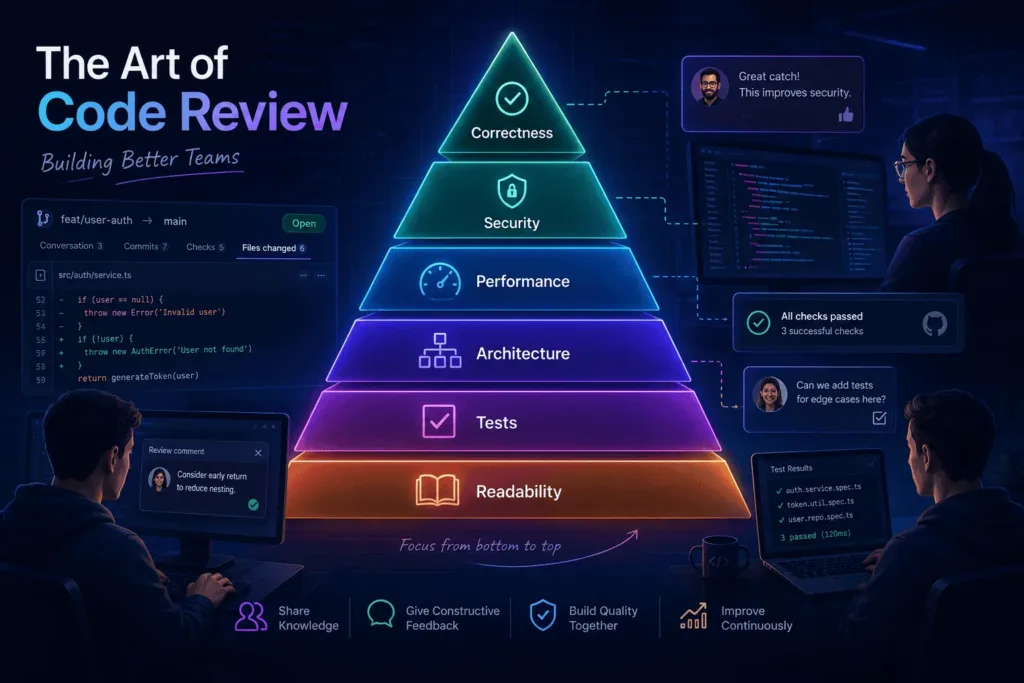
1. Correctness and Logic
- Does the code do what the PR description says it does?
- Are edge cases handled (empty inputs, nulls, concurrent writes, timeouts)?
- Are there off-by-one or boundary errors in loops and ranges?
2. Security
- Is user input validated and escaped before it touches a query, shell, or template?
- Are secrets pulled from the environment or vault, never committed?
- Are auth checks present on every endpoint that touches user data?
3. Performance and Scalability
- Are there N+1 queries hiding in a list view?
- Are caches invalidated correctly?
- Will this work at 100x the current load, or only at today’s scale?
4. Architecture and Boundaries
- Does this change respect module boundaries?
- Is the shared state added that creates new coupling?
- Is the abstraction the smallest one that solves the problem, or a speculative one?
5. Tests
- Are tests added for the new behavior, including the failure paths?
- Do the tests fail when the code is wrong (mutation test the change in your head)?
- Are tests deterministic, or will they flake on CI?
6. Readability
- Will a future engineer understand this in six months without context?
- Are names accurate?
- Are comments explaining why (non-obvious decisions) rather than what?
Style, formatting, import order, and lint rules are not on this list. Those belong to automated tools like Prettier, Black, ESLint, or your language’s standard formatter. If you are reviewing whitespace, your team is wasting human attention.
Common Code Smells to Flag
These are the patterns I flag almost every week:
- Silent error handling –
except: passor empty catch blocks that swallow signal. - Speculative abstraction – interfaces with one implementation and no second use case in sight.
- God functions – methods over ~50 lines doing three different jobs.
- Magic numbers and unexplained constants –
if user.score > 7with no comment on why 7. - Untested feature flags – flag added with no off-state test.
- Mutable shared state – module-level lists or dicts being written to from multiple call sites.
- Inconsistent error contracts – some functions throw, others return null, others return a tuple.
Flagging these consistently is what builds a team’s shared taste.
How to Give Code Review Feedback That Actually Lands
The single biggest unlock for review culture is learning to phrase feedback so the author wants to address it. Three rules I coach every reviewer on:
Rule 1 – Frame Suggestions as Questions
Instead of “This is wrong”, try “Have you considered using X pattern here? It might help with Y.” The question form invites a conversation; the verdict form invites defensiveness.
Rule 2 – Separate Mandatory from Optional
Use explicit prefixes:
nit:– small, optional, non-blocking.suggestion:– worth considering, but author’s call.question:– I want to learn or confirm something.blocking:– must be addressed before merge.
Most teams I work with adopt this convention within a sprint, and merge times drop noticeably the week after.
Rule 3 – Praise the Good Stuff
If someone writes a clean abstraction, an elegant test, or a thoughtful migration, say so in the review. Public, specific praise is what makes a reviewer’s harder feedback feel like coaching, not criticism.
Async vs Synchronous Code Reviews
Most reviews should be asynchronous. They give the author time to think, allow distributed teams to participate, and create a written record.
Move to a synchronous review (a 15-minute call or a screenshare) when:
- The PR is large and architectural (> ~500 lines of meaningful change).
- A comment thread has gone three or more rounds without convergence.
- The author and reviewer disagree on a fundamental approach.
- The change touches an unfamiliar area for one of the two parties.
In my experience, one short synchronous review can resolve what would have taken three days of async ping-pong – but defaulting to sync wastes everyone’s calendar.
How to Handle Code Review Disagreements
Disagreements are a signal, not a failure. Three patterns I use:
- Cost the disagreement – is this worth 30 more minutes of debate? If the cost of either approach is small and reversible, the author wins.
- Pull in a third reviewer – when two senior engineers deadlock, a third opinion almost always breaks the tie cleanly.
- Decide and document – once a decision is made, the author writes a one-line comment in the code or PR explaining the chosen tradeoff. The next reader thanks you.
The failure mode to avoid: a reviewer who blocks indefinitely without proposing a path forward. Block + propose is fine. Block alone is a process bug.
Code Review Tooling I Recommend
- GitHub Pull Request templates – encode the PR description checklist (description, screenshots, test plan, rollback) so authors don’t have to remember.
- CODEOWNERS files – auto-route reviews to the right people; cuts review-assignment latency.
- Reviewable.io – for repos with very large PRs and multi-round threads.
- Graphite or Sapling – for stacked PRs in trunk-based development.
- Conventional Comments – the
nit/suggestion/blockingprefixes mentioned above; spec at conventionalcomments.org. - Danger.js / Danger Ruby – automate the boring “did you update the changelog?” checks so reviewers never have to.
The rule of thumb: every minute you can move from human review to automation buys you a minute of attention on logic, security, and architecture.
A Practical Code Review Checklist (Copy This)
Keep this as a saved reply in your review tool:
[ ] PR description matches the diff
[ ] Edge cases and error paths handled
[ ] No new auth or input-validation gaps
[ ] No N+1 queries or obvious perf cliffs
[ ] Tests cover the change and the failure paths
[ ] No new public API without docs
[ ] No magic numbers without comments
[ ] Names accurate; future-reader friendly
[ ] Feature flag has both states tested
If all nine pass, approve. If one fails, comment with blocking: and a proposed fix.
Frequently Asked Questions
How long should a code review take?
Aim for under 24 hours per round. Research from Cisco’s classic SmartBear study found that review effectiveness drops sharply after 60 minutes per session and after 400 lines of code reviewed at a stretch. Break large PRs into smaller, reviewable units.
How big should a pull request be?
Under 400 lines of meaningful diff whenever possible. Reviewers’ defect-detection rate falls off a cliff above that threshold. Stack PRs or feature-flag partial work to stay under it.
Should junior engineers review senior engineers' code?
Yes – this is one of the highest-leverage growth practices on a team. Juniors learn the system fast, and seniors get a fresh-eyed read. The senior should treat junior questions as gold; the junior should ask without fear of looking dumb.
What is the difference between a nit and a blocking comment?
A nit is optional, stylistic, or trivially small – author can ignore. A blocking comment marks something the author must address before merge: a correctness bug, a security gap, a missing test for new behavior, or a violation of a team contract.
How do you handle a reviewer who is too harsh?
Coach them privately, not publicly. Share the conventional-comments prefix system, model the question-form rewrite, and pair them with a calmer reviewer for a week. Most harsh reviewers are not unkind – they have just never been taught that tone is part of the review.
Should code reviews be mandatory for every PR?
Yes, with one exception: trivially mechanical changes like dependency bumps, formatter-only diffs, or auto-generated migration files can be self-reviewed and merged. Everything else benefits from a second pair of eyes.
The Bottom Line
The best engineering teams I have worked with treat code review as the slowest channel through which culture moves. Every comment teaches; every approval signals trust; every block, paired with a fix, raises the floor.
Building a culture of constructive code review takes time. It is also one of the highest-return investments you will ever make in a team – better than any tool, framework, or process you can buy.